
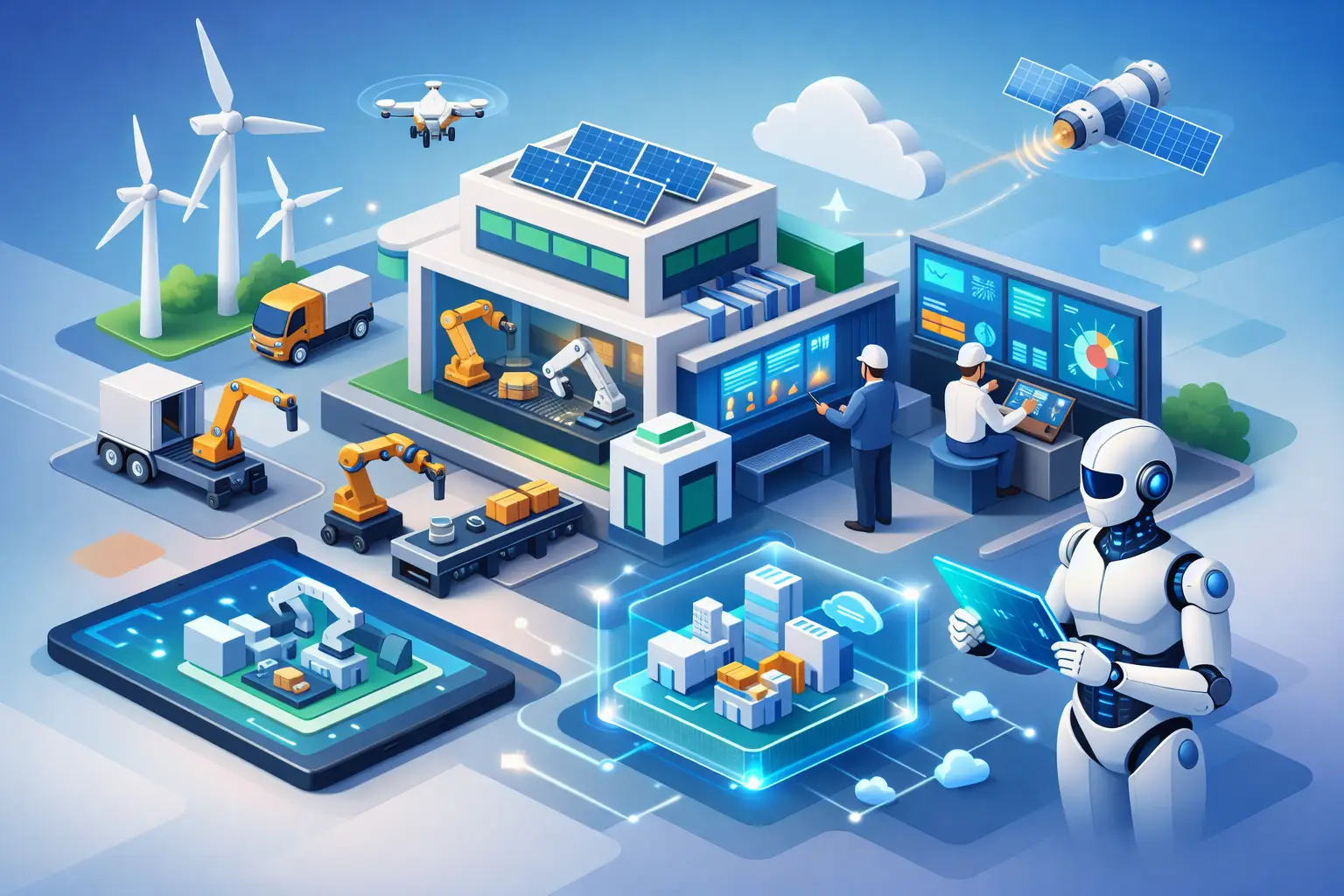
A factory footprint can look perfect on paper and still fail in execution. The reason is usually not the building itself. It is the missing ecosystem around it – logistics that add friction, workforce housing that sits too far away, permitting that slows ramp-up, or infrastructure that was never designed for high-value production. That is the gap the erisha smart manufacturing hub is built to close.
For industrial investors and advanced manufacturers, the question is no longer whether to expand into high-growth markets. The real question is where expansion can happen without compromising speed, cost control, workforce stability, or ESG commitments. A conventional industrial park solves for land. A future-facing manufacturing platform has to solve for operations.
What the Erisha Smart Manufacturing Hub is designed to do
The Erisha Smart Manufacturing Hub is positioned as more than an industrial address. It is a master-planned environment for companies that need production capacity, logistics performance, sector-aligned infrastructure, and a durable operating model in one place.
That distinction matters. Many industrial developments offer shell buildings, utility access, and transport connections. Fewer are designed around the full production lifecycle of advanced sectors such as electric vehicles, hydrogen mobility, semiconductors, renewable energy systems, and aerospace-adjacent manufacturing. Those sectors do not choose sites on land cost alone. They assess power reliability, cleanroom readiness, supplier adjacency, multimodal logistics, regulatory clarity, and the ability to attract and retain specialized talent.
The hub responds to that reality with a mixed-use industrial model. Purpose-built factories, modular industrial units, logistics facilities, and specialized production environments sit alongside residential, healthcare, education, retail, hospitality, and R&D assets. That changes the economic logic of the site. It reduces the operational drag that often appears after launch, when companies realize that production efficiency is tied to far more than the factory line.
Why ecosystem thinking now beats standalone industrial real estate
There is a structural shift underway in manufacturing site selection. Boards and operations teams are moving away from isolated real estate decisions and toward ecosystem decisions. The reason is simple. Scale has become more demanding.
A manufacturer entering a new market may need a faster commissioning timeline, a lower operating-cost base, a compliant ESG profile, and access to both regional and export markets. At the same time, it may need housing options for management teams, support services for a technical workforce, and room to expand without relocating in three years. If those pieces are fragmented across multiple jurisdictions or disconnected sites, hidden costs begin to accumulate.
That is where the erisha smart manufacturing hub gains strategic relevance. It is built around the idea that industrial growth works better when manufacturing, logistics, workforce support, and innovation assets are planned together from the start. For tenants, that can translate into lower coordination costs and fewer operational dependencies outside the development boundary.
This does not mean every company needs the same setup. A modular manufacturer with light assembly requirements may prioritize speed to occupancy and logistics access. A semiconductor-related operator may focus more on technical specifications, environmental controls, and utility resilience. An EV or hydrogen mobility company may care most about cluster adjacency and long-term scaling. The value of the hub is that it is structured to support those different operating profiles within one integrated framework.
Sector specialization is not a branding exercise
Industrial clusters work when they create practical advantages, not just marketing claims. Sector specialization only matters if it improves execution.
In the case of the Erisha Smart Manufacturing Hub, the emphasis on EVs, hydrogen mobility, eVTOL aircraft, semiconductors, and renewable energy production points to a clear development thesis. These are sectors with rising capital intensity, higher technical requirements, and growing policy relevance across the Gulf and global markets. They also benefit from co-location with suppliers, testing capabilities, logistics infrastructure, and innovation partners.
That has two consequences for occupiers. First, sector focus can reduce the mismatch between facility design and production needs. A cleanroom-ready environment, for example, is materially different from a standard industrial unit. Second, specialization can create a stronger institutional ecosystem over time, with investors, research collaborators, service providers, and government stakeholders aligned around industries that matter to future economic growth.
There is, however, a trade-off. Sector-led developments need disciplined execution to avoid becoming too narrow. The best hubs solve this by combining specialization with flexibility – supporting anchor industries while still accommodating adjacent technologies and different production scales. That balance is what gives a manufacturing destination resilience across market cycles.
Cost matters, but so does operating logic
Every expansion model starts with economics. Labor costs, utilities, land pricing, tax conditions, and freight access all shape investment decisions. But for sophisticated manufacturers, low cost by itself is not enough. The more useful question is whether the site supports efficient operations over a ten- to twenty-year horizon.
A lower-cost jurisdiction loses its edge quickly if inbound materials face delays, if export routes are inefficient, or if workforce churn rises because employees cannot build stable lives nearby. By contrast, a well-located manufacturing platform with port connectivity, investor-friendly regulations, and room for integrated support functions can improve total operating performance, even if headline occupancy costs are not the only factor in the equation.
That is the strategic logic behind locating advanced manufacturing in a hub connected to GCC and global markets while maintaining a more efficient cost base than many legacy industrial centers. For multinational firms, this creates optionality. They can serve regional demand, strengthen supply chain resilience, and establish a production base with expansion capacity instead of treating the facility as a short-term satellite operation.
ESG has moved from reporting language to site selection criteria
Manufacturing leaders increasingly face pressure to align expansion with sustainability targets, investor expectations, and national industrial priorities. That makes ESG compliance a practical requirement, not a communications layer.
An ESG-aligned industrial environment matters in tangible ways. Energy systems, building standards, mobility planning, land use, and community integration all affect emissions intensity, workforce outcomes, and regulatory positioning. Companies that ignore these factors may still open facilities, but they often face harder retrofits, weaker stakeholder narratives, and more scrutiny from customers and capital partners.
The Erisha Smart Manufacturing Hub addresses this by framing industrial development as part of a broader sustainable ecosystem. That is a stronger proposition than simply adding green features to conventional warehousing. It recognizes that environmental performance and operational performance are increasingly linked, especially in clean-tech and advanced manufacturing sectors where customers expect the production model to reflect the product story.
Why live-work-innovate infrastructure changes retention and growth
One of the most underestimated constraints in manufacturing expansion is workforce continuity. Companies can secure land and equipment, yet still struggle to maintain productivity because technical talent lacks nearby housing, family services, or quality-of-life support.
This is where mixed-use planning becomes a competitive advantage. When industrial operations are integrated with residential, healthcare, education, retail, hospitality, and R&D assets, the site becomes more than a workplace. It becomes a functioning talent ecosystem.
That matters for executives making long-term location decisions. Skilled engineers, technicians, plant managers, and support teams do not operate in isolation. Their retention depends on practical daily conditions as much as compensation. A development that helps companies support the full lives of their workforce can reduce friction that rarely appears in early financial models but often shapes long-term results.
It also matters for innovation. R&D capability, prototyping, manufacturing, and commercialization tend to move faster when they are physically connected. The closer those functions sit to each other, the easier it becomes to shorten feedback loops and accelerate production learning.
What strategic partners should be looking for next
For investors, occupiers, and institutional collaborators, the most useful lens is not whether a development looks ambitious. It is whether the ambition is backed by infrastructure logic, sector clarity, and long-horizon relevance.
That means asking practical questions. Is the site designed for advanced production, not just general industry? Can facilities adapt as technologies mature? Does the location support export efficiency and regional access? Is there enough ecosystem depth to attract talent and partner networks over time? And just as important, does the development align with the broader industrial direction of the markets it intends to serve?
The erisha smart manufacturing hub stands out because it answers those questions with an integrated model rather than a single asset class. It is not selling square footage alone. It is building a platform for industrial scale, sector concentration, and long-term economic value. For companies planning their next manufacturing base, that difference is not cosmetic. It shapes how fast they can launch, how well they can operate, and how confidently they can grow.
If the next era of manufacturing will be defined by cleaner technologies, smarter supply chains, and tighter links between production and innovation, then the winners will not be the companies that simply find space. They will be the ones that choose ecosystems built for what comes next.
