
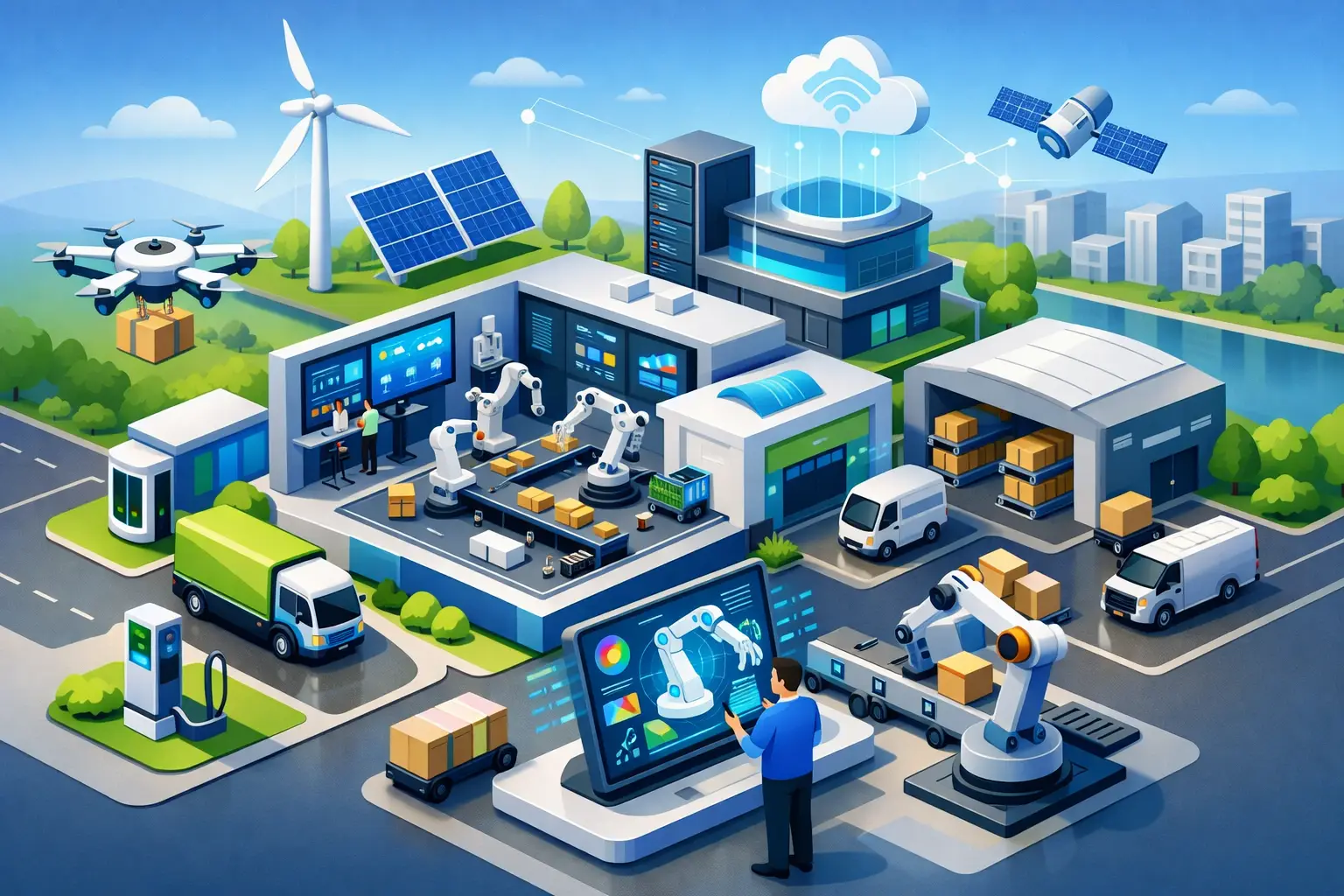
Capital moves toward platforms that reduce execution risk. That is the clearest answer to the question, Why to invest in Erisha smart manufacturing hub? For manufacturers, strategic investors, and technology companies, the real issue is not just where to build. It is where to scale faster, operate more efficiently, attract talent more reliably, and stay aligned with industrial policy, ESG expectations, and future market demand.
Erisha Smart Manufacturing Hub is positioned around that reality. It is not a conventional industrial park built on land arbitrage alone. It is a master-planned industrial ecosystem designed for advanced production, logistics performance, workforce stability, and long-term industrial relevance. That distinction matters because the next wave of manufacturing investment is moving away from isolated facilities and toward integrated environments that support production, innovation, and retention at the same time.
Why invest in Erisha Smart Manufacturing Hub now
Timing is not a side issue in industrial investment. It shapes returns. Across the Middle East and global growth corridors, manufacturers are under pressure to diversify supply chains, shorten delivery routes, localize production, and operate in jurisdictions that support expansion rather than slowing it down.
That has increased demand for industrial locations with three qualities: regulatory clarity, cost efficiency, and infrastructure built for advanced sectors rather than legacy use. Erisha meets that threshold by focusing on industries with structural growth behind them, including EVs, hydrogen mobility, semiconductors, renewable energy, aerospace-adjacent manufacturing, and clean-tech production.
This is where strategy becomes practical. Investors are not choosing between cheap land and premium capability. They are choosing whether a location can support high-value manufacturing without forcing expensive retrofits, fragmented logistics, or workforce instability. Erisha is built to avoid those failure points from the start.
A hub built for advanced manufacturing, not generic occupancy
Many industrial developments claim flexibility. Few are actually designed for specialized production. Advanced manufacturers need more than warehouses and basic utility access. They need purpose-built environments that can support technical requirements, phased expansion, and operational precision.
Erisha addresses that with turnkey factories, modular industrial units, logistics facilities, and cleanroom-ready spaces suitable for semiconductor and other high-spec manufacturing uses. For investors, this reduces one of the biggest hidden costs in industrial expansion: the time and capital required to adapt unsuitable infrastructure.
The value here is speed as much as readiness. If a business can move from market-entry planning to operating output faster, capital deployment becomes more efficient. Time-to-revenue shortens. Project risk declines. Expansion decisions become easier to justify at board level.
That is especially relevant for sectors where demand is moving quickly and facility quality directly affects product integrity, certification pathways, and operational uptime. Companies in emerging mobility, precision electronics, renewable systems, and next-generation component manufacturing do not need generic space. They need a location that already understands their operational profile.
For a closer view of what separates this model from standard industrial development, see How Erisha Smart Manufacturing Hub Is Different.
The real advantage is ecosystem design
Industrial investment performs better when infrastructure is matched by ecosystem depth. A facility may be technically sound, but if talent is hard to retain, leadership teams face long commutes, suppliers are disconnected, and daily life is inconvenient for employees, operational friction rises fast.
Erisha takes a different position. Its mixed-use model integrates industrial operations with residential, healthcare, education, retail, hospitality, and R&D assets in one ESG-compliant environment. That makes it a live-work-innovate platform rather than a single-use industrial zone.
For decision-makers, this has direct business value. It improves workforce attraction and retention, supports executive mobility, reduces productivity loss caused by fragmented urban planning, and creates a more stable operating base for long-term growth. In advanced manufacturing, talent continuity is not a lifestyle issue. It is a performance variable.
That is why mixed-use industrial development is becoming a serious strategic differentiator. The companies that scale successfully in new markets are often the ones that solve for people, not just plots.
This broader model is explored further in Why Erisha Smart Hubs Combine Living and Work.
Location strategy still decides margins
A strong industrial platform must also work on cost and connectivity. If operating expenses are inflated or market access is weak, even high-quality facilities become less competitive over time.
Erisha benefits from a location strategy built around lower operating costs, investor-friendly regulations, and access to port and regional trade corridors. For manufacturers serving GCC markets or building export capacity beyond the region, that matters at every level of the P&L. Transport efficiency, customs predictability, utility economics, and labor ecosystem quality all affect output cost.
This is one of the most common mistakes in site selection. Companies compare headline incentives or lease rates while underestimating the cumulative impact of logistics friction, infrastructure gaps, and expansion constraints. A cheaper location can become more expensive once delays, retrofits, and workforce churn are factored in.
A smart industrial investment should improve resilience as well as margins. Erisha is structured to support both by pairing geographic relevance with infrastructure that can absorb growth.
ESG is not a branding layer – it is an investment filter
Institutional capital and multinational manufacturers now assess industrial assets through a different lens than they did a decade ago. ESG compliance is no longer a secondary consideration. It shapes tenant demand, partnership quality, financing attractiveness, and long-term asset defensibility.
Erisha is positioned as an ESG-compliant industrial environment, which gives it relevance in a market where industrial occupiers increasingly need facilities that align with sustainability targets, cleaner production pathways, and stronger governance expectations. This is particularly important for sectors such as renewable energy, clean mobility, and semiconductor manufacturing, where supply chain scrutiny is rising.
The practical benefit is twofold. First, ESG-aligned infrastructure can help tenants meet their own reporting and stakeholder obligations with less operational redesign. Second, investors gain exposure to an industrial model that is better aligned with where capital allocation is going.
There is a trade-off worth stating clearly. ESG-compliant planning can require more discipline upfront in design, materials, utilities, and operational systems. But that is precisely why it creates better long-term positioning. The alternative is often delayed adaptation at higher cost.
For more context on this issue, What Makes Industrial Projects ESG Compliant? expands on the criteria sophisticated investors now watch closely.
Sector specialization creates stronger demand quality
Not all occupancy is equal. Industrial hubs built for everyone often struggle to create lasting strategic value for anyone. Erisha’s focus on high-growth sectors gives it a stronger investment logic because specialized clusters tend to attract better-fit tenants, stronger supplier relationships, and deeper innovation partnerships.
Dedicated clusters for EVs, hydrogen mobility, eVTOL aircraft, and renewable energy production reflect a thesis about where industrial demand is heading. These sectors need co-location advantages, technical infrastructure, and room for R&D-linked production. When those elements are planned together, the result is not just leased space. It is an ecosystem with compounding value.
This matters for investors evaluating future resilience. Specialized industrial environments are often better placed to maintain relevance because they are aligned with policy support, technology adoption, and long-cycle capital investment. Generic assets can fill space in the short term, but specialized platforms tend to build stronger long-term identity and stickier tenant relationships.
That is particularly true in aerospace-adjacent and mobility sectors, where precision, certification, and supply-chain integration shape facility demand. The same logic is visible in Erisha’s broader platform development, including Erisha Silicon Valley in Florida for Aerospace.
Why investors should think beyond real estate
The strongest case for Erisha is that it should not be viewed as a traditional real estate play. It is economic infrastructure. That changes how value is created.
Real estate thinking often starts with land, yield, and occupancy. Economic infrastructure thinking starts with industrial relevance, expansion capacity, ecosystem durability, and strategic alignment with national growth priorities. In that framework, the hub becomes a platform for manufacturing output, regional integration, innovation partnerships, and long-term enterprise value creation.
That is a different investment category with a different upside profile. It appeals not only to occupiers seeking operational efficiency, but also to strategic partners and institutions looking for participation in the industrial transformation underway across the region.
For companies deciding where to place their next production line, innovation base, or regional manufacturing platform, the better question may not be whether Erisha is attractive today. It is whether waiting will make entry more expensive once the market fully prices the value of sector-ready, ESG-aligned industrial ecosystems built for the future.
Rana Group has positioned Erisha around that future. For investors who value scale, readiness, policy alignment, and the ability to build where the future works, that is the reason to pay attention now.
