
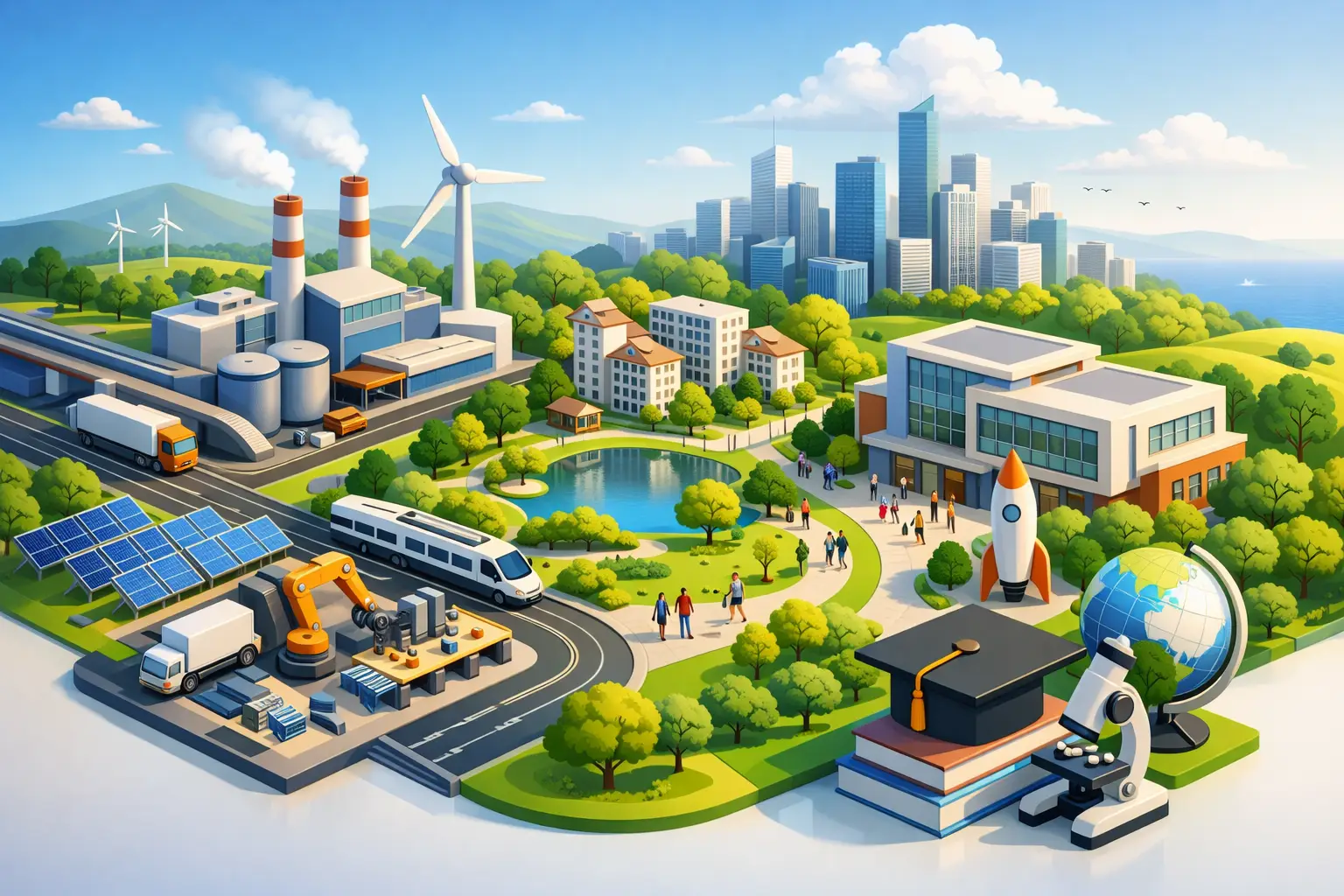
Industrial growth rarely fails because of ambition. It fails because the operating environment is fragmented. A company may secure land but not talent, build a factory but struggle with logistics, hire engineers but lose them to weak quality-of-life conditions. That is why the best ecosystem for industry living education and innovation is no longer a nice-to-have. It is becoming the baseline requirement for advanced manufacturing, clean technology, and high-value industrial expansion.
For investors and operators, this shift changes the site selection question. The issue is not simply where to place a facility. The real question is where an industrial business can scale, recruit, innovate, and stay competitive over the long term. In sectors such as EVs, hydrogen mobility, semiconductors, renewable energy, and aerospace-adjacent manufacturing, isolated industrial parks are starting to look like outdated infrastructure for a more integrated era.
What makes the best ecosystem for industry living education and innovation
The strongest industrial ecosystems are built on interdependence. Manufacturing does not thrive in a vacuum. It depends on logistics networks, workforce stability, research collaboration, utility reliability, regulatory clarity, and a surrounding environment that allows people to live well enough to keep high-skill operations running.
That means the best ecosystem for industry living education and innovation must combine hard infrastructure with human infrastructure. Factories, modular industrial units, warehousing, and specialized production spaces matter. But so do housing, healthcare, education, retail, hospitality, and R&D capacity. When these elements are planned together rather than added later, the result is operational efficiency that compounds over time.
This matters even more for companies entering new markets. A manufacturer expanding into the Middle East, for example, is not only evaluating utility costs or customs access. It is also assessing whether the ecosystem can support executives, engineers, technicians, suppliers, and institutional partners without forcing the business to solve every surrounding problem on its own.
The old industrial model is losing ground
Traditional industrial parks were designed around one core function: production. That model worked when supply chains were slower, labor was more localized, ESG scrutiny was lighter, and innovation cycles were less compressed. Today, those assumptions no longer hold.
High-value manufacturers need proximity to talent pipelines, testing environments, training partners, and specialized suppliers. They need facilities that can adapt to changing production methods. They need environments that help retain skilled workers in competitive labor markets. They also face pressure from investors, regulators, and customers to demonstrate sustainability performance, not just output volume.
An industrial location that offers cheap space but weak ecosystem depth may still look efficient on a spreadsheet. In practice, it can create hidden costs through turnover, transport delays, fragmented permitting, duplicated services, and slower commercialization of new technologies. For capital-intensive industries, those hidden costs can outweigh headline savings very quickly.
Why live-work-innovate environments outperform isolated sites
A true live-work-innovate ecosystem aligns operational needs with long-term business resilience. It shortens the distance between production, research, workforce development, and daily life. That proximity is not just convenient. It directly affects cost, speed, and execution.
When employees live near where they work, retention often improves. When training institutions are built into the ecosystem, companies reduce the lag between hiring demand and workforce readiness. When R&D and pilot-scale capabilities sit close to production infrastructure, innovation can move faster from concept to industrialization. When logistics assets are integrated into the same environment, throughput becomes more predictable.
This is especially relevant for sectors with complex technical requirements. Semiconductor-related manufacturing, cleanroom-ready production, battery assembly, hydrogen systems, and advanced mobility platforms all depend on precision environments and specialized support. These industries do not benefit much from generic industrial land. They benefit from ecosystems designed around sector needs from day one.
Infrastructure is still the foundation – but not the full story
No ecosystem can compensate for weak industrial fundamentals. Reliable power, water, transport access, digital connectivity, and scalable facility options remain non-negotiable. Investors and occupiers need confidence that infrastructure can support present operations and future expansion.
But advanced industrial decision-makers now look beyond baseline readiness. They ask whether the site can accommodate modular growth, specialized compliance requirements, and sector clustering. A clean-tech company may need room to test new systems. An EV supplier may need fast access to logistics corridors. An aerospace-adjacent manufacturer may require strict environmental controls and adjacent engineering support.
The best ecosystems anticipate these requirements rather than reacting to them. They offer turnkey factories where speed matters, modular industrial units where flexibility matters, and sector-specific spaces where technical performance matters. They also create room for suppliers, research partners, and adjacent operators to co-locate. That clustering effect builds momentum that single-tenant sites cannot replicate.
Education is not a support function. It is industrial strategy.
One of the biggest errors in industrial planning is treating education as secondary. In reality, workforce development is central to industrial competitiveness. A region can build world-class assets, but if it cannot produce, attract, and retain skilled talent, it will struggle to sustain advanced manufacturing growth.
Education within an industrial ecosystem should not be limited to general academic provision. It should include technical training, applied research partnerships, upskilling pathways, and direct alignment with employer needs. The closer these channels are to the operating base, the better the outcome for both employers and employees.
For strategic investors, this creates a stronger long-term case. It reduces dependency on imported talent alone, supports national economic priorities, and increases the probability that industrial activity can move up the value chain over time. In other words, education does not simply feed the workforce. It strengthens the entire investment proposition.
ESG performance now shapes industrial location strategy
Sustainability has moved from branding language to operating requirement. Industrial occupiers increasingly need locations that support emissions targets, resource efficiency, and responsible growth. Institutional investors are asking harder questions. Global customers are doing the same.
That is why ESG-compliant environments are gaining strategic value. Not every industrial park is designed to support renewable integration, efficient land use, lower-carbon logistics, or healthier community planning. The best ecosystems are.
This does not mean every company will prioritize ESG in the same way. Some will focus on energy sourcing. Others will look at water management, reporting standards, or worker well-being. But the broader direction is clear. Industrial infrastructure that aligns with sustainability goals is becoming easier to finance, easier to justify, and more attractive to global partners.
Geography still matters, but ecosystem depth matters more
Location remains a major factor in industrial expansion. Access to ports, trade corridors, regulatory clarity, and regional markets can create immediate competitive advantage. Lower operating costs can also improve the economics of large-scale manufacturing.
Yet geography without ecosystem depth has limits. A site may sit near major shipping routes and still underperform if it lacks workforce support, sector specialization, or integrated services. By contrast, a well-planned manufacturing hub can turn location into a multiplier by combining connectivity with liveability, innovation capacity, and industrial readiness.
This is where a next-generation development model stands apart. A master-planned environment that integrates advanced manufacturing space with logistics, residential assets, healthcare, education, retail, hospitality, and R&D offers a stronger platform for durable industrial growth. That is the logic behind ecosystems such as Erisha Smart Manufacturing Hub, where industrial development is structured as long-term economic infrastructure rather than a standalone property play.
How investors and operators should evaluate an ecosystem
The right question is not whether a site looks impressive at launch. The right question is whether it can support industrial performance for the next ten to twenty years. That requires a wider evaluation lens.
Decision-makers should assess whether the ecosystem supports rapid setup, phased expansion, and specialized production needs. They should examine whether housing, services, and education are close enough to strengthen workforce retention. They should test the quality of logistics access, regulatory environment, and ESG alignment. They should also consider whether the hub is attracting the right mix of tenants, suppliers, and innovation partners.
There are trade-offs, of course. Highly specialized ecosystems may not suit every manufacturer. Some businesses still benefit from simpler, lower-cost industrial formats. Others may prefer a distributed model if their labor and supply chain needs are highly decentralized. But for advanced sectors with long investment horizons, integrated ecosystems increasingly offer the stronger strategic base.
The future of industrial development will not be defined by square footage alone. It will be defined by whether industrial sites can function as complete economic systems – places where production scales, talent stays, ideas move faster, and investment compounds. That is what separates a conventional industrial park from the best ecosystem for industry living education and innovation.

[…] wants to retain skilled labor over the long term, it has to think beyond factory walls and into the full operating environment that shapes daily […]