
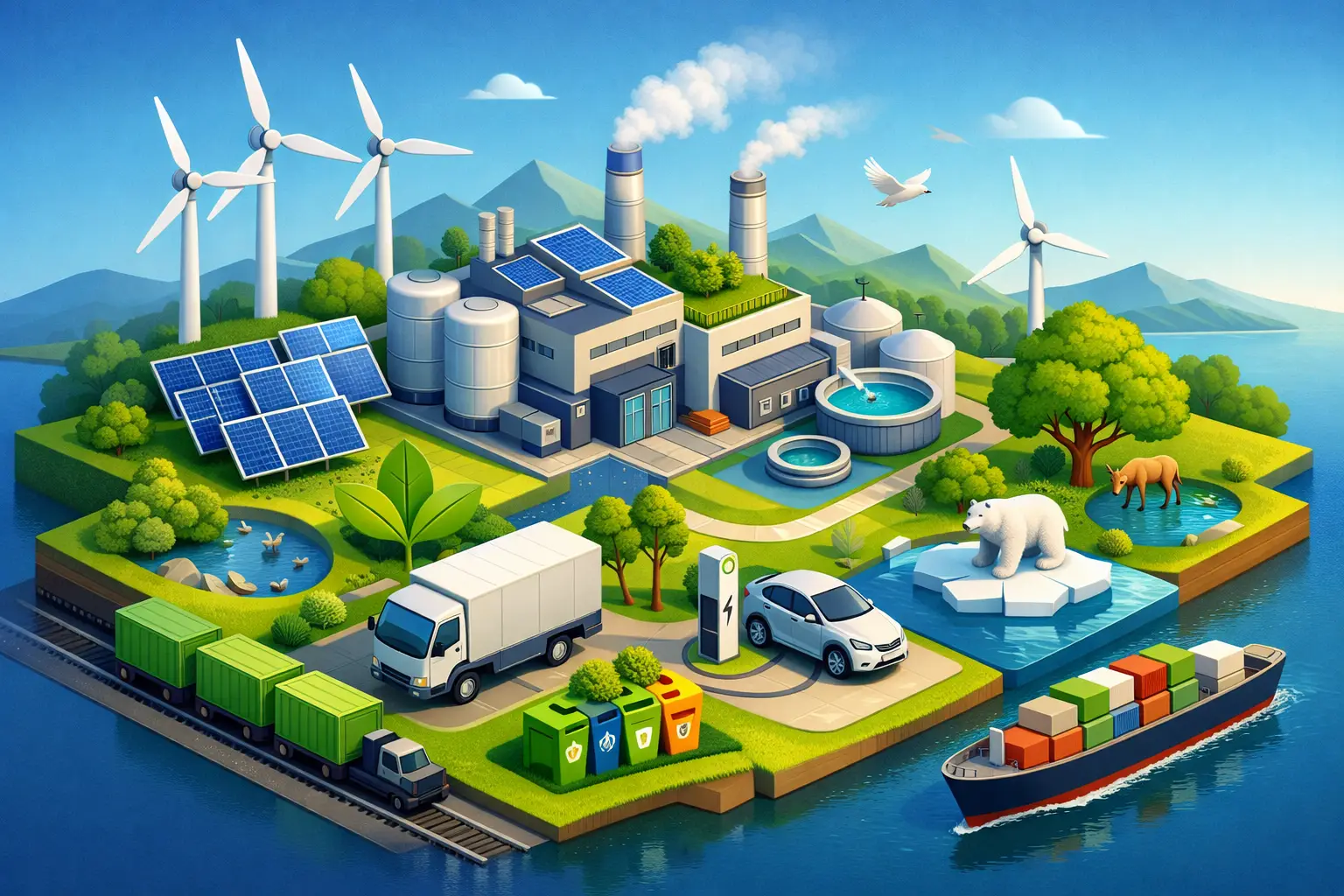
Industrial real estate is no longer judged on land, power, and logistics alone. For manufacturers, investors, and strategic partners, Top ESG Industrial Features now sit much closer to the center of site selection because they influence operating cost, regulatory readiness, workforce stability, and long-term asset value.
That shift is especially visible in advanced manufacturing. EV platforms, hydrogen mobility, semiconductors, aerospace-adjacent production, and renewable energy supply chains do not just need floor space. They need infrastructure that can support compliance, decarbonization pathways, talent attraction, and resilient operations over decades, not leasing cycles. In that environment, ESG is not a branding layer. It is industrial strategy.
What Top ESG Industrial Features Really Signal
The strongest ESG-led industrial environments signal something deeper than environmental intent. They show that a development has been planned for modern production realities, where energy intensity, water usage, labor expectations, and supply chain scrutiny all affect competitiveness.
For an occupier, that means ESG features should be evaluated as operating infrastructure. If a site can lower utility volatility, improve mobility access for labor, reduce waste handling friction, and support future reporting requirements, it creates measurable business value. If it cannot, the hidden cost shows up later through retrofits, compliance pressure, recruitment difficulty, and weaker investor positioning.
This is why sophisticated buyers look beyond surface-level claims. Solar panels on a roof may be useful, but they do not define a high-performing industrial ecosystem on their own. The real question is whether the development has embedded ESG into design, utilities, land use, mobility, and tenant operations.
Top ESG Industrial Features for Future-Ready Manufacturing
The most valuable ESG industrial features usually sit at the intersection of sustainability and operational control. They help companies protect margin while preparing for tighter standards across global markets.
Energy infrastructure built for transition
A credible industrial site should be designed for energy efficiency from the outset, with building envelopes, cooling systems, lighting strategy, and load management aligned to industrial demand. But the higher-value feature is flexibility. Occupiers increasingly need the ability to integrate renewables, battery storage, smart metering, and, in some sectors, future hydrogen or alternative energy systems.
This matters because energy transition is not uniform across industries. A cleanroom-ready semiconductor facility has very different load characteristics from an EV component plant. The best developments account for that complexity by creating infrastructure that can evolve with tenant demand rather than forcing expensive redesigns later.
Water efficiency and industrial water management
Water risk is moving up the board agenda, particularly in regions where industrial growth and climate pressure are converging. ESG-aligned industrial developments should include systems for water-efficient operations, wastewater treatment compatibility, reuse potential, and responsible stormwater planning.
For manufacturers, the practical benefit is straightforward. Better water planning reduces exposure to supply disruption, lowers treatment-related inefficiencies, and strengthens the case for permitting and stakeholder trust. In sectors with process-heavy production, it can become a serious differentiator.
Waste systems that support circular production
Waste handling is often treated as a tenant issue, but mature industrial ecosystems build it into the platform. That includes segregation capacity, recycling pathways, material recovery planning, and logistics that support circularity at scale.
This is especially relevant for high-value manufacturing, where scrap, packaging, process materials, and hazardous byproducts require disciplined management. A site that makes circular practices easier can improve compliance and lower waste-related costs. A site that ignores this usually pushes operational friction back onto the tenant.
Low-carbon mobility and logistics planning
Industrial ESG does not stop at the factory wall. Transport emissions, employee commuting, freight efficiency, and last-mile connectivity all affect the environmental profile and day-to-day performance of an industrial base.
That is why mobility infrastructure has become one of the Top ESG Industrial Features for serious occupiers. Electric vehicle charging, freight circulation planning, multimodal access, and reduced congestion design all influence carbon outcomes and throughput reliability. For sectors tied to next-generation mobility, these features also reinforce strategic alignment with the products being manufactured.
The Social Features Investors Should Not Undervalue
Environmental performance gets the headlines, but social infrastructure is often where industrial developments either gain resilience or lose it. Manufacturers do not scale on land alone. They scale on people, and people increasingly make decisions based on quality of life, not only wages.
Integrated workforce ecosystems
A strong industrial platform should support access to housing, healthcare, training, education, and daily services within or near the development ecosystem. This is not an amenity story. It is a labor strategy.
When industrial hubs fail to account for the realities of workforce life, tenant retention suffers. Commute burdens rise, turnover increases, and specialist talent becomes harder to secure. By contrast, integrated live-work environments create a more stable labor base and strengthen the long-term attractiveness of the location for multinational occupiers.
For advanced manufacturing, where technical roles are harder to replace, this is a board-level issue. Social infrastructure becomes operational infrastructure.
Health, safety, and wellbeing by design
The baseline expectation is safe industrial space. The higher standard is a development that designs for worker wellbeing through air quality, circulation, emergency readiness, thermal comfort, and access to support services.
These features may sound secondary to heavy industry, but they have direct implications for productivity and employer brand. In sectors competing for engineers, technicians, and specialized operators, the workplace environment matters. It affects recruitment, absenteeism, and organizational reputation.
Skills pipelines and innovation adjacency
Industrial growth is increasingly linked to education and R&D proximity. Sites that enable training partnerships, technical education pathways, and applied research collaboration are stronger ESG propositions because they contribute to long-term economic inclusion and skills development.
They also make business sense. Occupiers in fast-moving sectors need access to future talent and innovation networks, not just current labor supply. Industrial ecosystems that connect production with learning and research are better positioned for sustained relevance.
Governance Features Separate Serious Platforms From Marketing Claims
Governance is often the least visible ESG category, but for investors and multinational manufacturers, it is where confidence is built. A development may offer attractive sustainability language, but governance determines whether those commitments can be measured, enforced, and improved over time.
Transparent compliance and reporting readiness
As ESG disclosure expectations tighten across markets, occupiers want sites that can support data capture and reporting, especially around energy, water, waste, and emissions. Developments that provide monitoring infrastructure and clear operating standards help tenants reduce administrative burden and improve reporting credibility.
This is particularly important for global manufacturers with group-level sustainability targets. If a facility cannot generate reliable data, ESG commitments become harder to verify and defend.
Clear land use, regulation, and long-term planning
Industrial investors do not want sustainability to sit in tension with permitting or operational certainty. They want an environment where governance is visible through zoning discipline, infrastructure phasing, compliance clarity, and development controls that protect long-term value.
That is one reason master-planned industrial ecosystems are gaining strategic weight. They can align environmental performance, industrial use, and community planning in a more coherent way than fragmented sites. In locations such as Ras Al Khaimah, where industrial expansion, export access, and cost discipline matter, this model becomes even more relevant for globally mobile capital.
How to Evaluate ESG Features Without Falling for Surface-Level Positioning
Not every ESG claim deserves equal weight. Industrial decision-makers should test whether a feature changes operational performance or simply improves presentation.
A practical filter is to ask four questions. Does the feature lower long-term operating cost? Does it reduce compliance or transition risk? Does it improve tenant resilience? Does it strengthen workforce attraction or investor credibility? If the answer is no, the feature may still be positive, but it is probably not strategic.
It is also worth looking at interdependence. A green building in an isolated industrial zone may perform well on paper and still underperform as an ecosystem. By contrast, a mixed-use industrial platform with integrated logistics, workforce infrastructure, utility planning, and sector-specific facilities may generate stronger ESG outcomes because the system is designed to work as a whole.
That systems view is where the market is heading. Top ESG Industrial Features are no longer individual checkboxes. They are the architecture of industrial competitiveness.
Why the Next Decade of Industrial Growth Will Favor ESG-Led Ecosystems
The next wave of industrial investment will be shaped by more than incentives and land availability. Capital is moving toward locations that can support advanced manufacturing, satisfy stakeholder expectations, and absorb future policy shifts without constant retrofit.
That favors industrial environments built around specialized infrastructure, integrated communities, and measurable ESG performance. It also favors developers thinking beyond the standard industrial park model. Rana Group’s ecosystem approach reflects that broader shift, where industrial growth is planned alongside talent, services, innovation, and sustainability from day one.
For decision-makers evaluating expansion in the Middle East or other high-growth corridors, the message is clear. ESG features matter most when they make industry easier to scale, safer to operate, and stronger over time. The right platform does not ask tenants to choose between sustainability and performance. It is built to deliver both.
