
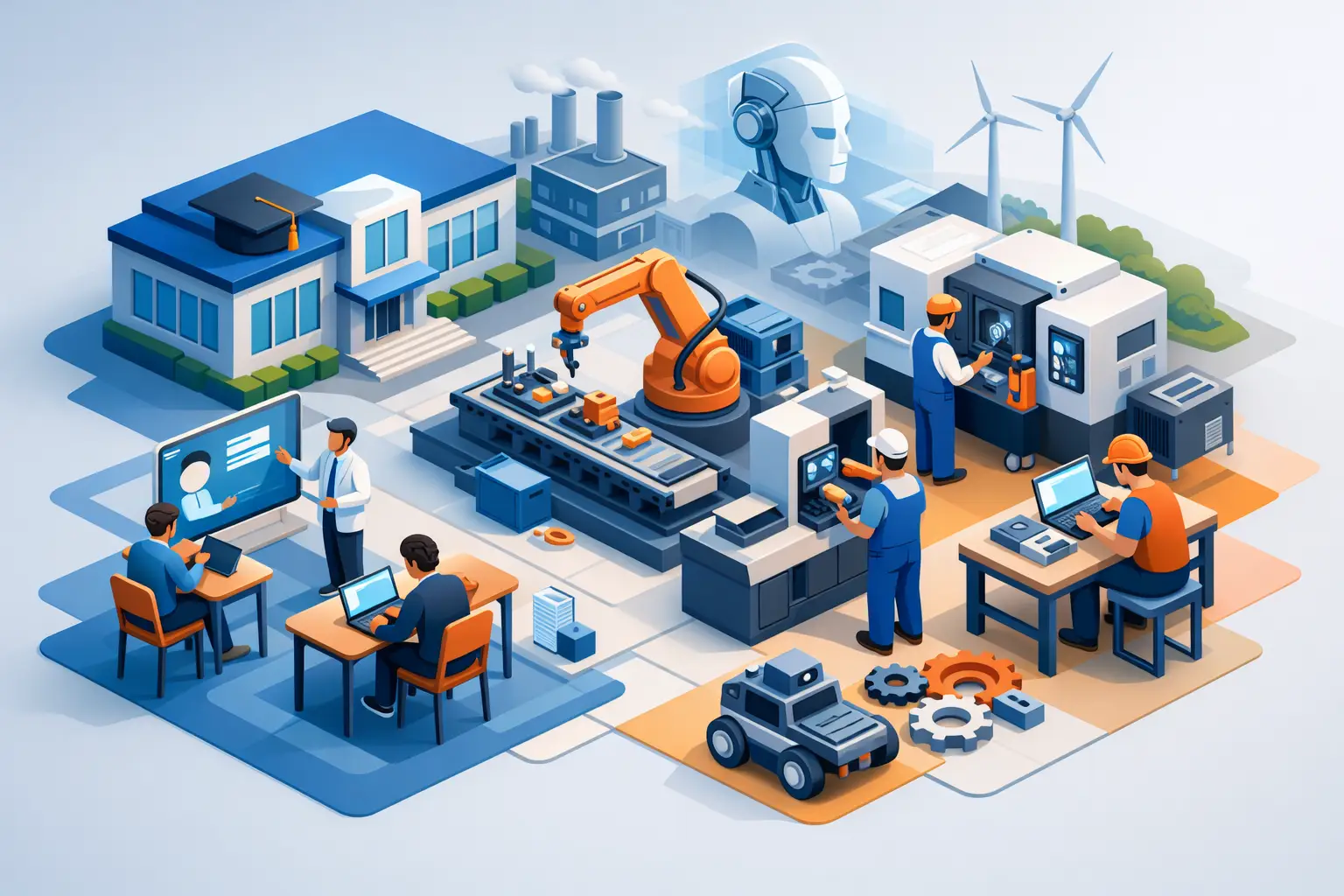
A factory can be commissioned in months. A high-value workforce cannot. That is why education infrastructure for manufacturing talent has moved from a secondary planning issue to a primary investment variable for industrial hubs, advanced manufacturers, and long-term capital partners.
For companies entering sectors like EVs, semiconductors, hydrogen mobility, precision engineering, and renewable energy systems, the workforce question is no longer just about headcount. It is about whether a location can continuously produce technicians, operators, maintenance specialists, process engineers, quality leaders, and manufacturing managers at the speed of industrial growth. If that pipeline is weak, every other advantage – land, utilities, incentives, and logistics – starts to lose force.
Why education infrastructure for manufacturing talent now shapes site strategy
Manufacturing has changed faster than many labor systems have. Production environments are becoming more automated, quality thresholds are rising, and compliance expectations are becoming tighter across safety, sustainability, and traceability. The result is straightforward: the talent requirement is more specialized, more dynamic, and more difficult to fill through traditional hiring alone.
This is particularly true in emerging industrial clusters. A region may offer cost efficiency, strategic geography, and investor-friendly regulation, but if training systems remain disconnected from actual industrial demand, employers inherit the burden. They spend more on onboarding, face longer ramp-up periods, and carry greater operational risk during expansion.
Education infrastructure solves that gap when it is built as part of the industrial platform rather than treated as an afterthought. In practical terms, that means technical institutions, applied learning centers, industry-led certification pathways, and employer-linked training capacity designed around real production systems. It also means creating an environment where workers and their families can commit for the long term, because retention is as critical as recruitment.
What strong education infrastructure actually includes
A serious education strategy for manufacturing is not limited to one vocational school or a set of classroom programs. It is a layered system that supports the full workforce lifecycle.
At the entry level, manufacturers need reliable pathways for technicians, machine operators, assemblers, and quality staff. These pathways should be tied to equipment, processes, and production standards that reflect current industrial reality, not outdated training models. A graduate trained on generic concepts but unfamiliar with automated inspection, cleanroom protocols, or digital production systems will still require significant retraining.
At the mid-skill level, employers need continuous upskilling. Industrial teams must adapt to new lines, new materials, new software environments, and stricter environmental standards. Education infrastructure is strongest when it allows learning to continue after hiring through modular certifications, shift-friendly training, and applied programs linked to operational needs.
At the leadership level, advanced manufacturing hubs need supervisors, maintenance planners, production engineers, and operations managers who understand both technical systems and industrial scaling. That talent is rarely created through classroom instruction alone. It develops where academic institutions, R&D environments, and live industrial operations are in close proximity.
This is why integrated industrial ecosystems have an advantage. When training, production, housing, healthcare, and research assets exist within one development logic, workforce formation becomes faster and more durable.
The case for integrated hubs over isolated industrial parks
Traditional industrial parks were designed around land parcels, utility access, and transport links. Those remain essential, but they do not answer the next-generation talent challenge. Advanced manufacturing depends on ecosystem depth.
A company deciding where to place a clean-tech plant or electronics assembly line is not simply evaluating a site. It is evaluating whether the surrounding environment can sustain technical labor over five, ten, or fifteen years. That includes the presence of training institutions, but also the conditions that make skilled workers stay: quality housing, healthcare access, family services, mobility, and a sense of career progression.
This is where education infrastructure for manufacturing talent becomes inseparable from broader development planning. If workers must commute long distances, relocate families without support, or leave the region to advance their skills, attrition rises. Employers then face a recurring cycle of replacement and retraining that undermines output and increases cost.
By contrast, integrated hubs can align industrial demand with educational programming and community infrastructure. The result is not just a larger labor pool. It is a more stable one.
How manufacturers should assess education infrastructure before expansion
For investors and occupiers, the question is not whether talent matters. The question is how to evaluate talent infrastructure with the same rigor used for power capacity, permitting timelines, and logistics performance.
First, assess proximity between industry and training. A technical institution located far from industrial operations may contribute to the regional labor pool, but it will struggle to deliver rapid feedback loops. Manufacturers benefit most when curricula can be updated in direct response to factory requirements.
Second, look at specialization. General technical education has value, but advanced sectors require more. Semiconductor-supporting environments, clean energy manufacturing, aerospace-adjacent production, and EV systems all require distinct competencies. A broad labor market is useful. A sector-aligned labor system is more valuable.
Third, examine employer participation. The strongest models are not purely academic. They are built with employers shaping coursework, equipment selection, certification priorities, and internship design. If industry is absent from the training structure, mismatch is likely.
Fourth, evaluate lifestyle infrastructure around talent. This point is often underestimated in boardroom discussions. Workforce reliability is affected by whether people can live well near where they work. Education infrastructure works better when paired with residential, healthcare, and social amenities that make industrial communities more attractive to skilled labor and their families.
The investment logic is stronger than many assume
Some decision-makers still treat education as a public-sector concern rather than a core industrial asset. That view no longer reflects how competitive manufacturing ecosystems are built.
When talent infrastructure is weak, costs appear in multiple places: delayed production launches, lower first-pass yield, higher supervisory burden, increased expatriate dependence, and persistent recruitment friction. These are not soft issues. They are measurable operational constraints.
When education infrastructure is strong, the upside compounds. Ramp-up times improve. Internal promotion becomes more realistic. Technology adoption becomes less disruptive. ESG performance can also improve because workforce development is increasingly tied to social impact expectations, local value creation, and long-term economic resilience.
That is especially relevant for manufacturers entering regions positioned for industrial diversification. Governments want high-value industry, but high-value industry requires talent systems that can grow with it. The most credible industrial platforms are therefore those that treat education as part of hard infrastructure, not adjacent to it.
Education infrastructure for manufacturing talent is a competitiveness issue
There is also a larger strategic point. Education infrastructure for manufacturing talent is not just about filling jobs inside one facility. It is about whether a region can become a durable manufacturing base rather than a short-cycle cost play.
Low operating costs may attract initial interest. Strategic port access may accelerate feasibility. Regulatory clarity may help investment committees move faster. But without a dependable talent engine, long-term competitiveness weakens.
That is why next-generation industrial developments are increasingly built as complete ecosystems. They combine purpose-built manufacturing space with logistics readiness, sector-specific clusters, innovation capacity, and workforce-supportive social infrastructure. In this model, education is not a peripheral service. It is part of the production architecture.
This is also the logic behind ecosystem-led industrial planning seen in serious manufacturing destinations. The strongest developments are designed to support not only factory occupancy, but labor continuity, industrial learning, and multi-stage value creation. That is a more mature proposition for global manufacturers looking to establish regional scale.
For organizations evaluating future manufacturing platforms, the right question is not simply, “Can we hire here?” It is, “Can this location keep producing the talent our operation will need as we scale, automate, and move up the value chain?”
That distinction matters. Hiring solves today. Education infrastructure shapes the next decade.
At Rana Group, this broader view of industrial development reflects a simple reality: the future of manufacturing will belong to ecosystems that build talent capacity with the same seriousness they build factories. For investors and operators planning long-horizon growth, that is not a social add-on. It is a strategic edge.
The industrial hubs that lead the next era will not be the ones with space alone. They will be the ones where the future workforce is already being built.

[…] is designed to support more than occupancy. It is designed to support production continuity, workforce retention, sector clustering, investment confidence, and expansion capacity over […]
[…] They scale inside ecosystems where precision suppliers, testing capabilities, logistics access, workforce pipelines, digital engineering, and capital formation reinforce one another. In a market where timelines are […]
[…] do not evaluate a location only by rent or plot size. They look at housing access, commute times, education options for families, healthcare proximity, lifestyle quality, and whether the location supports long-term stability. […]
[…] is where education becomes inseparable from industrial planning. If a hub is serious about future industries, it must also be serious about where future talent […]
[…] manufacturer cannot. These businesses commit to land, power, logistics, compliance, workforce pipelines, and multiyear capex schedules. They need a location where the rules are clear, the direction is […]
[…] industrial platforms increasingly combine manufacturing space with residential, healthcare, education, and daily-life infrastructure that improves workforce attraction and retention. This is especially relevant for technically […]
[…] question is not which model is cheaper on paper. It is which model can support scale, resilience, talent, compliance, and speed over the next […]