
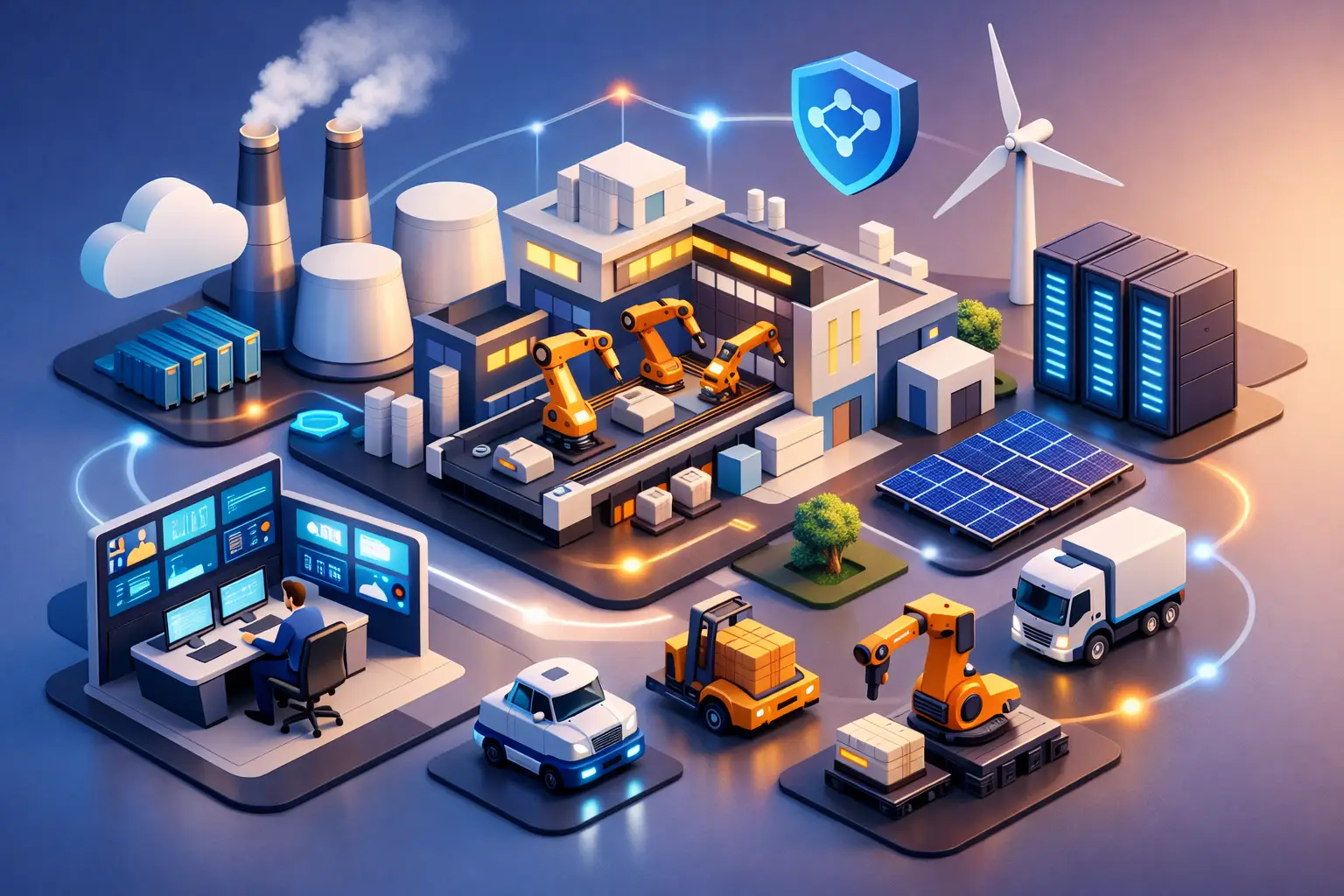
A factory expansion fails long before equipment arrives. It fails when power loads are underestimated, when logistics yards cannot handle throughput, when cleanroom conversion was never engineered into the shell, or when workforce housing sits too far from the production line to support shift stability. That is why any advanced factory infrastructure guide worth reading has to start with a hard truth – industrial performance is shaped by infrastructure decisions made years before operations begin.
For investors, manufacturers, and strategic partners, advanced factory infrastructure is no longer a background issue handled after land acquisition. It is now a board-level decision. The sectors driving the next industrial cycle – EVs, hydrogen mobility, semiconductors, aerospace-adjacent systems, and renewable energy components – require facilities that can scale fast, meet compliance standards, absorb technology upgrades, and support highly skilled labor in a competitive market. The question is not whether infrastructure matters. The question is whether the platform was designed for the industry you are building.
What an advanced factory infrastructure guide should actually cover
Too much market discussion reduces industrial infrastructure to roads, utilities, and plot size. That may be enough for light assembly or standard warehousing. It is not enough for high-value manufacturing.
A serious advanced factory infrastructure guide must evaluate the full operating environment. That includes utility reliability and redundancy, heavy vehicle circulation, process water strategy, environmental controls, data capacity, cleanroom readiness, fire and safety engineering, permitting clarity, and expansion logic across phases. It should also examine whether the surrounding ecosystem supports workforce retention, supplier access, R&D collaboration, and executive confidence in long-term deployment.
This is where many industrial projects separate into two categories. Some are industrial parks with available space. Others are industrial ecosystems built to support sector-specific growth over time. The difference becomes obvious once a tenant needs to increase power demand, add precision manufacturing lines, segregate hazardous processes, or recruit specialized labor at scale.
Infrastructure is now a competitiveness issue
In advanced manufacturing, infrastructure is not just a cost item. It is a determinant of speed to market, unit economics, compliance risk, and capital efficiency.
Consider an EV components manufacturer evaluating regional expansion. A lower land price may look attractive at first, but that advantage disappears if the site requires major utility upgrades, long permitting cycles, or offsite logistics workarounds. The same applies to semiconductor-adjacent production. A building shell without cleanroom-ready planning is not a near-term opportunity. It is a future retrofit cost.
Industrial leaders are increasingly selecting locations based on how much uncertainty the infrastructure removes. Can the site support phased scaling? Are logistics movements efficient from gate to highway to port? Is the industrial environment compatible with ESG targets and investor reporting expectations? Does the broader development reduce friction for talent, partners, and service providers?
If the answer to those questions is unclear, expansion timelines stretch and risk premiums rise.
The core layers of advanced factory infrastructure
The strongest industrial platforms are built in layers. Each layer affects operational resilience and long-term value creation.
The first layer is physical capacity. This includes land planning, building specifications, floor loading, ceiling height, loading docks, crane compatibility, road geometry, and space for utilities and storage. These features sound basic, but they determine whether a factory can accommodate process changes without major structural redesign.
The second layer is technical readiness. Power, backup systems, cooling, compressed air, water treatment, waste handling, digital connectivity, and environmental control systems all need to match the intensity of the intended manufacturing process. A modular industrial unit can work well for some occupiers, while others need a turnkey facility or a highly customized shell built around compliance, contamination control, or precision production.
The third layer is logistics integration. Factory value drops when trucks queue inefficiently, ports are too distant, customs processes are slow, or suppliers face inconsistent transit windows. Advanced manufacturing depends on predictable movement of inputs, components, and finished goods. Infrastructure that connects efficiently to regional and global trade routes creates a measurable operating advantage.
The fourth layer is ecosystem support. This is where many projects fall behind. A factory does not operate in isolation. It depends on engineers, technicians, service providers, training partners, healthcare access, and quality-of-life assets that help retain labor and leadership teams. For advanced industrial tenants, the surrounding environment often determines whether the facility can sustain growth beyond its first operating phase.
Why sector specialization matters in an advanced factory infrastructure guide
Not all advanced manufacturers need the same infrastructure, and pretending they do creates expensive mismatches.
A hydrogen mobility company may prioritize hazardous materials planning, wide logistics access, energy-intensive operations, and room for demonstration or pilot systems. An eVTOL manufacturer may care more about precision assembly environments, testing support, supply chain clustering, and regulatory coordination. A renewable energy components producer may require large-format production space and efficient outbound logistics for bulky finished goods. Semiconductor-related operations may need cleanroom-ready conditions, contamination controls, and utility reliability at a different standard altogether.
This is why generic industrial stock is often a poor fit for future-facing sectors. Purpose-built infrastructure, dedicated clusters, and flexible facility formats can reduce deployment time and lower adaptation costs. There is a trade-off, of course. Highly specialized infrastructure can narrow the pool of suitable tenants if the sector thesis is weak. But where demand is clear and national industrial policy supports growth, specialization creates stronger tenant alignment and greater long-term relevance.
The location equation is bigger than geography
Executives often ask the same opening question: where should the factory go? The better question is: which location can support the full economics of operation over ten to twenty years?
That means balancing land and utility costs with labor access, regulatory efficiency, trade connectivity, and expansion capacity. It also means assessing whether the jurisdiction is aligned with industrial growth, investor protection, and sustainability reporting expectations.
In the Gulf, this calculus is becoming more sophisticated. Manufacturers are looking beyond a simple market-entry foothold. They want a base that can serve the GCC, connect to global shipping routes, support industrial exports, and operate within a pro-investment framework. When lower operating costs are combined with access to ports, specialized industrial zoning, and scalable infrastructure, the location stops being a compromise and starts becoming a strategic advantage.
Building for ESG without compromising industrial performance
ESG is now part of industrial infrastructure strategy, but serious operators know the issue is not branding. It is performance, compliance, and capital access.
An ESG-aligned industrial environment can improve energy efficiency, reduce emissions intensity, support water stewardship, and strengthen investor confidence. It can also help occupiers meet customer procurement standards and future regulatory requirements. Yet there are trade-offs. Some sustainability features raise upfront capital costs or require more complex planning. The value appears over time through lower operating expense, better reporting, and stronger market positioning.
The most effective approach is integration at the master-planning stage rather than retrofitting after occupancy. This is especially relevant for large industrial ecosystems designed to host clean-tech, mobility, and advanced manufacturing sectors that will face rising scrutiny on environmental performance.
From factory site to industrial ecosystem
The next generation of manufacturing hubs is moving beyond the old model of isolated plots and disconnected warehouses. The stronger model combines industrial facilities with logistics, R&D capacity, workforce support, and adjacent community assets.
That matters because advanced manufacturing is a talent-intensive business. Engineers and technical operators do not evaluate jobs on wage alone. They look at commute times, housing quality, schools, healthcare access, training pathways, and the broader stability of the operating environment. Investors look at the same ecosystem through a different lens – lower churn, better productivity, faster ramp-up, and stronger long-term occupancy performance.
This integrated model is central to why large-scale developments such as Erisha Smart Manufacturing Hub are gaining attention. They are designed not simply as places to produce, but as environments where industrial operations, innovation capacity, and workforce life can coexist in one planned framework. That shift is strategic. It reduces friction across the full operating system.
How decision-makers should use this guide
The practical use of an advanced factory infrastructure guide is not to create a generic checklist. It is to ask better investment questions before capital is committed.
Decision-makers should test whether a site can support current process requirements and future process evolution. They should ask how quickly space can be occupied, expanded, or reconfigured. They should evaluate whether the developer understands the tenant’s sector or is simply offering land with broad claims about flexibility. They should also examine the ecosystem around the plant, because labor resilience and supplier coordination will shape output just as much as utility capacity.
The strongest industrial opportunities now come from places built with strategic intent – infrastructure that is sector-aware, expansion-ready, logistically connected, and aligned with the industries shaping the next decade.
Factories do not become future-ready by adding more square footage. They become future-ready when infrastructure, geography, and ecosystem planning are treated as one investment decision from day one.
