
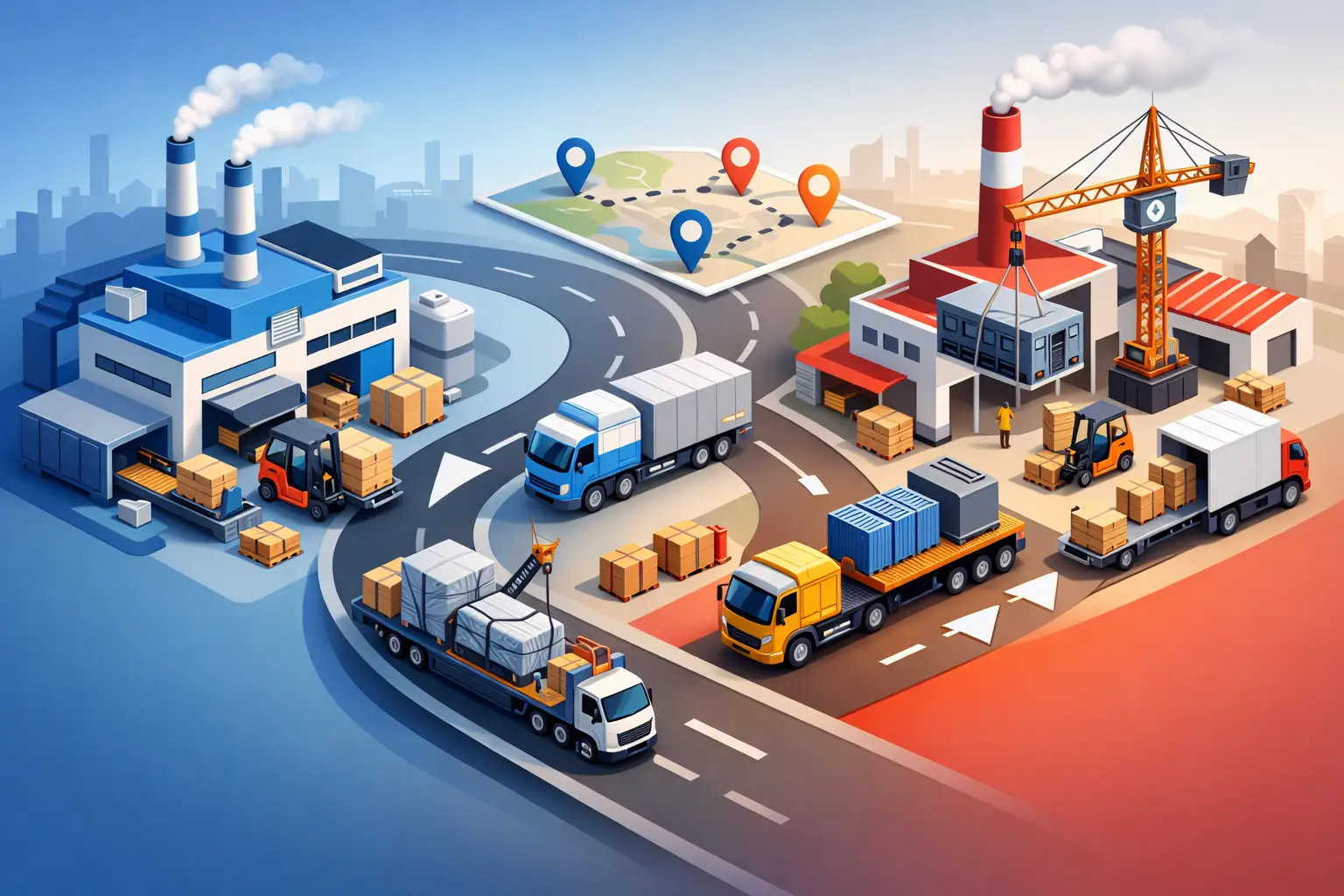
A factory move rarely fails because the freight bill was too high. It fails because leadership underestimated the full cost of interruption. Factory relocation costs are shaped less by the truckload and more by what happens before shutdown, during transfer, and after recommissioning – especially when production lines, regulatory approvals, utilities, and workforce continuity are all in play.
For manufacturers operating in advanced sectors, relocation is not a real estate exercise. It is an operational reset with direct consequences for yield, customer delivery, compliance, and long-term margins. That is why the smartest companies do not ask, “What will the move cost?” They ask, “What is the cost of moving badly, and what is the value of moving into a better industrial platform?”
What factory relocation costs really include
The most visible line items are usually transport, rigging, dismantling, and installation. Those matter, but they are only one layer of the budget. In practice, factory relocation costs often spread across six different categories: facility exit costs, asset movement, new site preparation, production downtime, workforce transition, and compliance.
A simple manufacturing line can be moved with relatively predictable logistics. A high-specification plant is different. If the operation depends on cleanroom conditions, specialized ventilation, heavy power loads, water treatment, hazardous materials handling, or strict process validation, relocation becomes a capital event. The new site must be ready not just to receive equipment, but to reproduce operating conditions at the required standard.
This is where many budgeting models fall short. They treat the move as a one-time transportation project, when the real financial exposure sits in recommissioning, calibration, and delayed ramp-up.
The biggest cost drivers in a factory relocation
Equipment complexity and sensitivity
Not all machinery moves the same way. A stamping press, a CNC cluster, a battery assembly line, and a semiconductor-related process tool each carry different relocation requirements. Weight, fragility, alignment tolerances, contamination risk, and utility dependencies all change the budget.
Sensitive equipment often requires specialist handling crews, custom crating, environmental controls in transit, and extensive testing after installation. If production quality depends on micron-level tolerances or contamination control, the cost of validation can rival the cost of transport itself.
Downtime and lost output
For many manufacturers, downtime is the largest hidden number in factory relocation costs. A plant that is offline for two weeks does not just lose production volume. It may trigger missed delivery windows, contract penalties, expedited shipping later, and customer confidence issues that linger long after the machines are running again.
The true cost depends on how relocation is staged. Some companies can move in phases and maintain partial output. Others must shut down fully. In high-growth sectors such as EV components, energy systems, or aerospace-adjacent manufacturing, even short interruptions can be expensive because order books are tight and supply chains are already synchronized around delivery commitments.
Building readiness at the destination
A new site can either compress relocation costs or inflate them quickly. If a factory shell needs major upgrades to power capacity, floor loading, HVAC, compressed air, process water, safety systems, or cleanroom fit-out, the move budget expands well beyond logistics.
This is one reason purpose-built industrial environments matter. When infrastructure is aligned with the needs of advanced manufacturing from the start, companies avoid spending time and capital forcing an unsuitable building to behave like a specialized production asset. That difference can reshape both project timelines and return on investment.
Regulatory approvals and compliance
Permits, inspections, environmental approvals, customs processes, and local operating licenses can materially affect schedule and cost. Cross-border relocation adds another layer, especially where machinery importation, dual-use technologies, or sector-specific certifications are involved.
Compliance costs are rarely dramatic in one invoice. They accumulate through consultant fees, legal reviews, testing, documentation, and delays. For highly regulated operations, relocation planning should account for the fact that production cannot resume simply because equipment is physically installed.
Workforce transition
Factories do not run on infrastructure alone. They run on trained operators, engineers, maintenance specialists, quality teams, and supervisors who understand the process deeply. If a relocation requires labor migration, new hiring, retraining, or temporary staffing, those costs can be substantial.
There is also a strategic dimension. If the destination lacks housing, healthcare access, education, or daily convenience for employees, workforce retention can become a post-move problem. That turns relocation into a recurring labor cost issue rather than a one-time project expense.
Why the cheapest move is not always the lowest-cost move
There is a difference between minimizing moving expenses and optimizing total relocation economics. A lower lease rate in an isolated site can look attractive on paper, yet create higher logistics costs, workforce churn, slower approvals, and larger infrastructure retrofits. Over a five- or ten-year horizon, that decision can cost far more than choosing a better-prepared industrial base.
This is where boards and expansion leaders need a wider lens. Factory relocation costs should be measured against long-term operating performance. If a new location improves port access, energy reliability, expansion capacity, ESG alignment, and talent retention, the upfront move can create structural savings that justify the transition.
In other words, relocation should not be framed only as cost containment. It should be evaluated as industrial repositioning.
How to model factory relocation costs with more accuracy
A realistic model starts with production logic, not property logic. Before pricing transport or fit-out, decision-makers need a line-by-line understanding of what must move, what should be replaced, what can be upgraded, and what needs parallel commissioning to protect continuity.
The next step is scenario planning. One scenario might assume a full shutdown and rapid transfer. Another might stage production in waves. A third might combine relocation with automation upgrades or process redesign. Each scenario changes cost timing, risk exposure, and post-move productivity.
It also helps to separate hard costs from strategic costs. Hard costs include dismantling, freight, permits, facility preparation, and contractor fees. Strategic costs include customer disruption risk, delayed product launches, talent loss, and management bandwidth. The latter are harder to quantify, but ignoring them leads to weak investment decisions.
For multinational manufacturers, the model should also include jurisdictional variables such as tax structure, customs efficiency, land availability, utility pricing, and the speed of expansion approvals. A site that supports the next two growth phases may be more valuable than one that only solves the current move.
When relocation costs rise – and when they fall
Costs rise when companies move into buildings that were never designed for their production profile. They also rise when relocation is treated as a procurement exercise rather than a cross-functional transformation program. Last-minute design changes, fragmented contractors, unclear permitting pathways, and weak restart planning create expensive friction.
Costs tend to fall when the destination offers ready infrastructure, sector-compatible utilities, scalable land or unit options, and an ecosystem that supports both operations and workforce needs. For advanced manufacturers, a well-planned hub can reduce the number of custom interventions required before production starts.
That is why industrial ecosystems are increasingly relevant to relocation strategy. In a master-planned environment built for manufacturing, the economics improve beyond the move itself. Companies gain adjacency to logistics, suppliers, innovation partners, and talent-supportive amenities. For some occupiers, that converts relocation from a defensive necessity into a platform for expansion.
Rana Group’s approach reflects that broader shift: not just accommodating factories, but building environments where advanced industry can scale with fewer structural constraints.
The decision that matters most
The central question is not whether factory relocation costs are high. They usually are. The real question is whether those costs are buying a better operating future.
If the destination lowers long-term operating friction, supports compliance, improves supply chain access, and gives the business room to grow, then relocation becomes an investment in competitiveness. If it only shifts the address while preserving the same constraints, the move is far harder to justify.
The strongest industrial leaders treat relocation with the seriousness of a capital program. They align finance, operations, engineering, compliance, and workforce planning early. They price risk honestly. And they choose locations not just for immediate occupancy, but for the quality of the industrial ecosystem around them.
That is where factory relocation moves from cost management to strategic advantage – and where the future works better for the manufacturers prepared to build into it.
