
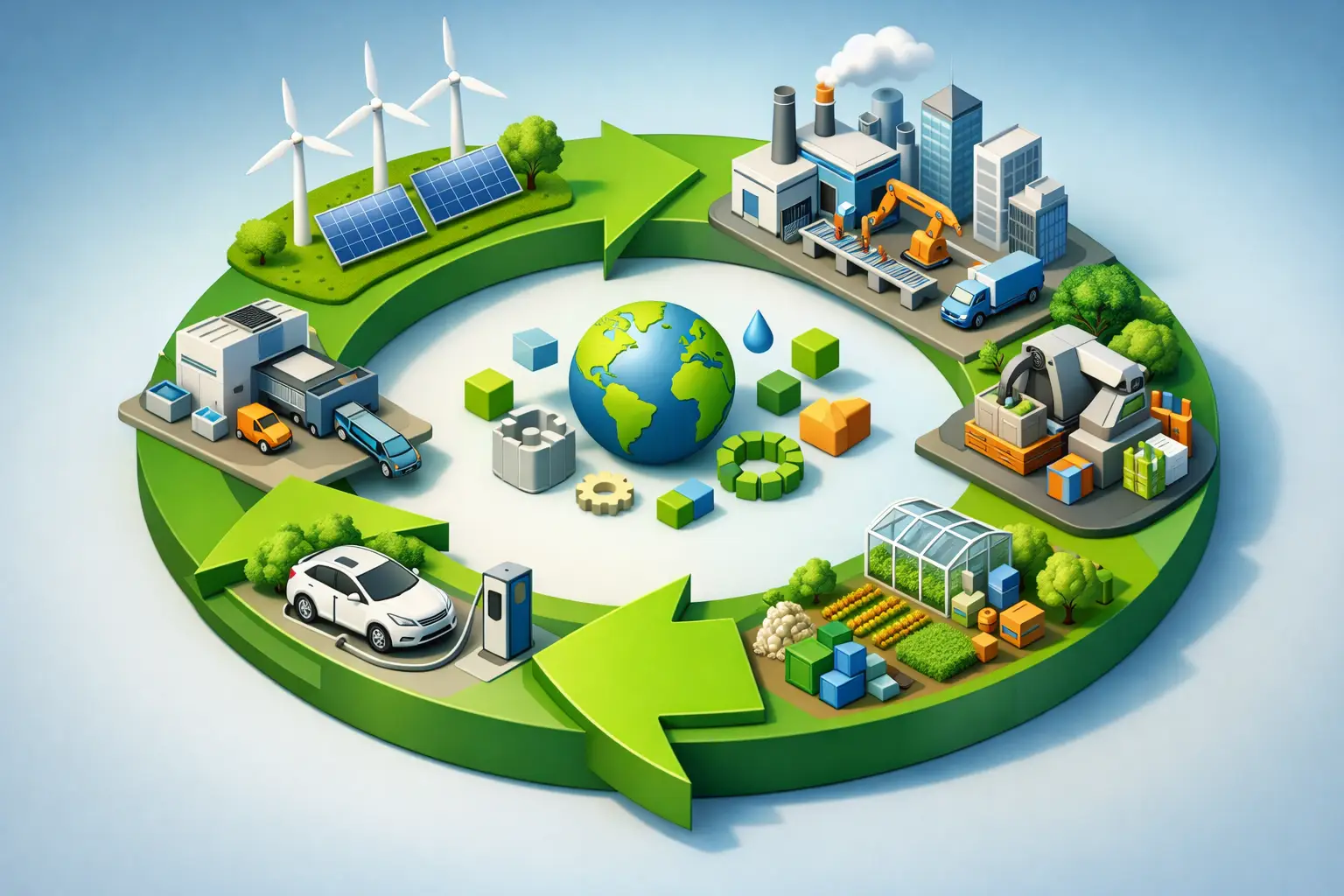
Waste is no longer just an environmental issue. For manufacturers, it is a margin issue, a supply chain issue, and increasingly, a market access issue. That is why the Circular Economy has moved from sustainability language into boardroom strategy.
For industrial leaders, the shift matters because the old linear model – take, make, use, discard – is proving expensive and fragile. Raw material volatility, tighter ESG standards, carbon pressure, and growing customer scrutiny are exposing the limits of waste-heavy production. A circular model offers a different path: keep materials in use longer, recover more value from assets, design out waste, and build industrial systems that perform better over time.
What the Circular Economy means in practice
At its core, the Circular Economy is an operating model built around resource efficiency and value retention. It asks manufacturers to rethink how products are designed, how facilities are run, how byproducts are managed, and how materials can re-enter production instead of leaving the system as waste.
That can mean designing components for repair and reuse rather than disposal. It can mean using recycled feedstocks where quality allows. It can mean industrial symbiosis, where the waste stream of one operation becomes the input of another. In advanced manufacturing, it also includes smarter asset use through predictive maintenance, digital tracking, and modular production environments that reduce stranded capital.
This is not a soft concept. It is a hard operational discipline with direct implications for cost structure, resilience, and compliance.
Why Circular Economy strategy is becoming a competitive advantage
The strongest case for circularity is not ideology. It is industrial performance.
Manufacturers that reduce material waste improve yield. Businesses that recover heat, water, metals, and process inputs reduce exposure to volatile commodity pricing. Operators that design for remanufacturing or refurbishment create new revenue streams from existing products. In sectors such as EVs, semiconductors, clean energy systems, and advanced mobility, these gains are becoming strategically significant rather than incremental.
There is also a location advantage. Circular performance depends on infrastructure. A manufacturer can only recover, sort, store, remanufacture, or exchange materials efficiently if the surrounding industrial environment supports it. This is one reason the next generation of industrial growth is moving toward integrated ecosystems rather than isolated facilities. As explored in The Future of Smart Industrial Hubs, industrial value increasingly comes from how assets connect, not just how they are built.
The infrastructure behind a circular industrial model
A Circular Economy does not run on ambition alone. It requires physical and operational systems that are often missing from conventional industrial parks.
First, facilities must be designed for efficiency from day one. Energy performance, water recovery, waste segregation, and logistics flow all influence whether circular practices are commercially viable. Why Net Zero Ready Industrial Buildings Matter is closely tied to this reality, because circularity and decarbonization often depend on the same design decisions.
Second, the surrounding ecosystem matters. If suppliers, processors, logistics operators, workforce housing, R&D functions, and utilities are fragmented across distant locations, circular models become harder to execute. Material recirculation slows down. Transport costs rise. Collaboration drops. A true live-work-innovate environment creates better conditions for closed-loop manufacturing because the industrial network is planned, not improvised.
Third, governance matters. ESG compliance is no longer a branding exercise for serious industrial investors. It is becoming part of financing criteria, procurement qualification, and tenant strategy. A circular industrial platform works best when ESG standards are embedded into the broader operating environment, not treated as an add-on. That is the distinction behind What Makes an Industrial Park ESG Compliant?.
Where circular models work best
Not every sector moves at the same speed. High-volume, materials-intensive industries tend to see the clearest gains first. Battery ecosystems, EV manufacturing, electronics, packaging, metals, chemicals, and renewable energy components all have strong circular potential because they face significant material costs and increasing pressure around lifecycle performance.
That said, circularity is not always simple. In some sectors, recovered materials may not yet meet performance requirements. In others, regulation, certification, or traceability standards can slow adoption. For multinational manufacturers, the right question is not whether circularity is universally easy. It is where circular interventions produce the highest return with the lowest operational disruption.
That is why the most future-ready industrial platforms are being designed around sector clusters. Cluster strategies make circular exchange more realistic because related industries share infrastructure, utilities, suppliers, and recovery pathways. Rana Group’s ecosystem model reflects this direction by aligning advanced manufacturing growth with ESG-ready infrastructure, specialized industrial environments, and the broader support systems companies need to scale with confidence.
The investment lens
For investors and expansion leaders, Circular Economy strategy should be evaluated like any other strategic lever: by its impact on margin, resilience, compliance, and long-term asset relevance.
The industrial winners of the next decade will not simply produce more. They will produce with less waste, lower resource intensity, and stronger lifecycle economics. They will choose locations that support closed-loop operations, not just basic occupancy. And they will view circularity not as a reporting line, but as a design principle for industrial growth.
That shift is already underway. The question for manufacturers is no longer whether the circular model is relevant. It is whether their facilities, partners, and expansion strategy are built to capture its value.
