
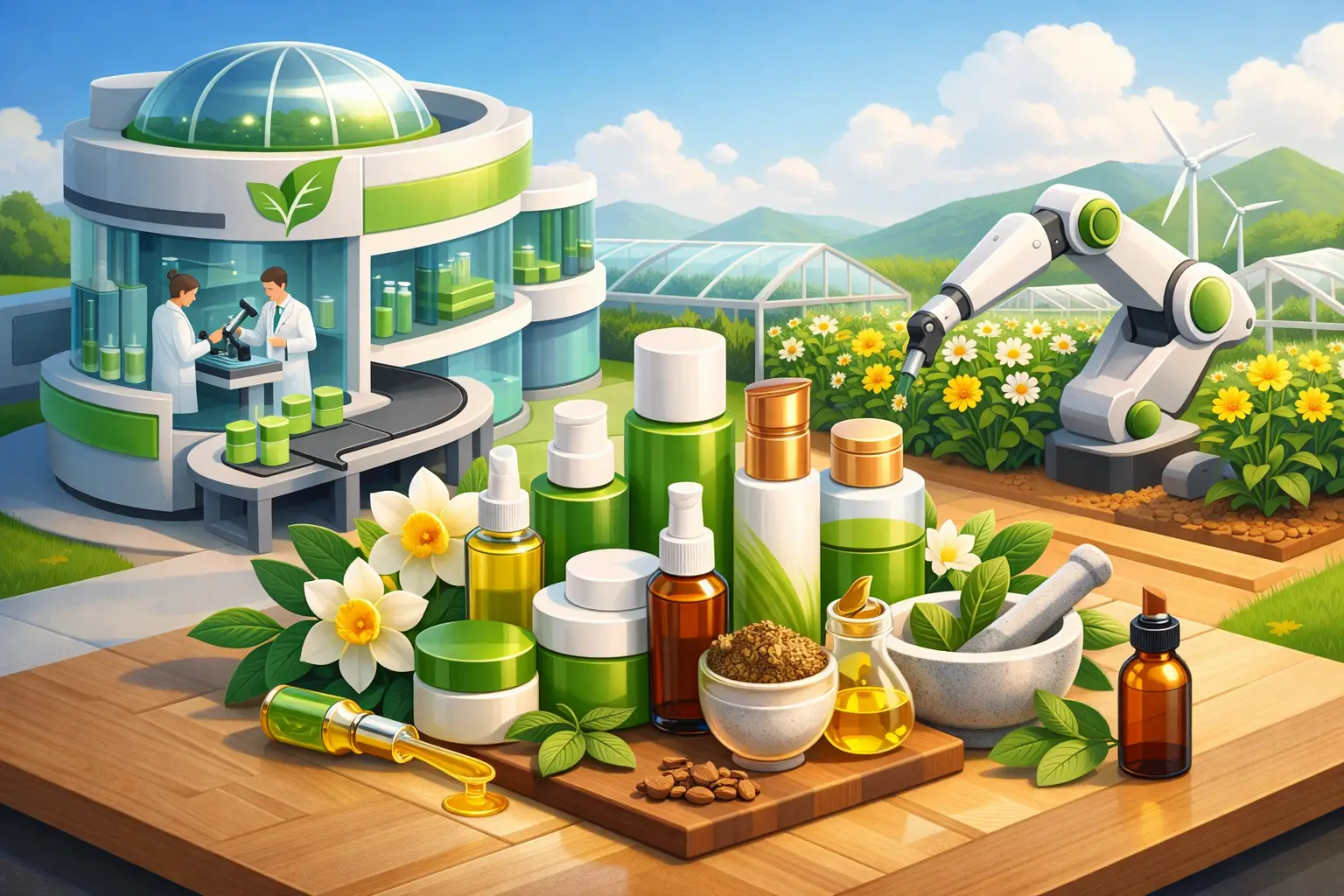
Industrial platforms rarely signal market intent this clearly. Erisha Longevity is going to produce Narges Herbal food supplements, Herbal cosmetics, herbal medicines and Herbal beverage in Erisha Smart Manufacturing Hub, and that matters far beyond one product portfolio. It points to a bigger shift – longevity, wellness, and plant-based health categories are moving into advanced industrial ecosystems built for scale, compliance, and cross-border growth.
For investors, manufacturing partners, and strategic occupiers, this is not a soft consumer story. It is an infrastructure story. When a longevity-led portfolio enters a smart manufacturing environment, the real question is not whether demand exists. Demand already exists. The question is whether production can meet modern expectations around quality systems, traceability, ESG alignment, speed to market, and regional distribution. That is where Erisha changes the equation.
Why Narges production fits Erisha Smart Manufacturing Hub
Narges product categories sit at the intersection of consumer wellness, regulated production, and brand-sensitive manufacturing. Herbal food supplements require consistency in formulation, ingredient handling, and packaging integrity. Herbal cosmetics demand controlled production conditions, strong quality management, and the ability to scale without compromising brand trust. Herbal medicines raise the bar further, where manufacturing discipline, documentation, and facility readiness become central. Herbal beverages add another layer through volume, storage, and distribution logistics.
Housing these categories inside Erisha Smart Manufacturing Hub is strategically coherent because the hub is designed as an operating environment, not simply a land offering. That distinction is critical. Manufacturers in growth sectors do not only need square footage. They need infrastructure that reduces operational friction and protects long-term expansion. In practice, that means purpose-built industrial assets, logistics readiness, utility planning, and a wider ecosystem that supports workforce stability and innovation.
This is one reason the hub has relevance for longevity-driven manufacturing specifically. Wellness and herbal product businesses often begin with strong market positioning but hit constraints when they attempt to industrialize. Facility upgrades become expensive. Compliance requirements multiply. Supply chains become harder to coordinate. Market access becomes dependent on execution, not vision. A smart hub built for industrial performance shortens that gap between ambition and repeatable output.
Erisha Longevity and the industrialization of wellness
The announcement that Erisha Longevity will produce Narges herbal lines inside the hub signals a more mature phase of the wellness economy. For years, herbal products were often framed as niche, artisanal, or fragmented. That framing no longer holds. The category now demands industrial-grade production systems capable of serving regional and international markets with confidence.
That has direct implications for capital allocation. Investors and manufacturing decision-makers increasingly prefer sectors where consumer tailwinds align with scalable production. Longevity, preventive wellness, nutraceuticals, botanical formulations, and functional beverages all fit that profile, but only if manufacturing is anchored in the right environment. Without that foundation, growth can become chaotic. With the right foundation, category expansion becomes measurable and defensible.
Erisha Smart Manufacturing Hub gives this sector an industrial base with strategic relevance. It allows herbal and wellness manufacturing to operate within a broader ecosystem shaped by advanced production, integrated logistics, ESG priorities, and live-work infrastructure. For companies evaluating where the next wave of health-oriented manufacturing will happen, that positioning matters.
What this means operationally
The strength of this move is not the product list alone. It is the production logic behind the product list. Supplements, cosmetics, medicines, and beverages each carry different manufacturing needs, but they also share common requirements: quality assurance, raw material control, packaging coordination, warehousing, batch traceability, and route-to-market efficiency.
A fragmented location strategy can handle one or two of these needs. It struggles when all of them must work together. A smart manufacturing hub creates room for integration. Formulation, production, packaging, storage, and dispatch can be planned as part of one system rather than scattered functions. That lowers complexity and can improve both cost discipline and speed.
There are, of course, trade-offs. Herbal medicines and beverages do not follow identical production pathways. Cosmetic manufacturing may require different environmental controls than supplement lines. Regulatory pathways may differ by product category and target market. But those differences are easier to manage in a master-planned industrial environment than in isolated facilities with limited expansion capacity.
This is where infrastructure becomes a strategic asset rather than a background cost. Companies entering the Middle East or expanding from within it are not simply looking for buildings. They are looking for manufacturing environments that can absorb complexity without slowing growth.
Why the Erisha model matters for herbal product manufacturing
Erisha Smart Manufacturing Hub was conceived as an industrial ecosystem that combines production with the conditions needed to sustain long-term operations. That includes industrial space, logistics access, R&D relevance, and the surrounding residential, healthcare, education, retail, and hospitality ecosystem that helps tenants attract and retain talent.
For a category like herbal wellness, this matters more than many assume. The challenge is not only producing a product. The challenge is maintaining operational consistency while building a brand, managing standards, and preparing for wider distribution. Businesses that scale in this space need more than manufacturing lines. They need an environment that supports technical teams, management functions, vendor networks, and market-facing execution.
That ecosystem approach is part of what makes the hub different. Readers who want the broader context can see how that integrated model is framed in Why Erisha Smart Manufacturing Hub Has It All. The value is not abstract. It is operational. A hub that brings infrastructure and daily life into one coordinated setting reduces friction across the business.
The longevity sector is especially well suited to that model. As explored in Why Erisha Smart Manufacturing Hubs Fit Longevity, this is a category built on long-term consumer trust, disciplined production, and the ability to evolve product portfolios over time. Those are not one-year advantages. They are ecosystem advantages.
A signal to strategic partners and occupiers
When Erisha Longevity moves to produce Narges herbal supplements, cosmetics, medicines, and beverages, it sends a message to more than the wellness market. It signals that Erisha Smart Manufacturing Hub is a credible base for sectors that combine consumer demand with manufacturing complexity.
That should matter to contract manufacturers, packaging specialists, formulation partners, cold chain and warehousing providers, raw material processors, and investors seeking adjacency opportunities. Industrial ecosystems become more valuable when sector clustering begins to form. One tenant category creates momentum for another. Once a hub begins attracting complementary capabilities, the advantage compounds.
This is not limited to wellness. It reflects the broader thesis behind sector-led industrial development. Rather than offering generic industrial inventory, Erisha is building specialized environments for future-relevant industries. In that context, herbal and longevity manufacturing becomes part of a wider portfolio of next-generation production activity.
For occupiers considering fit, Who Can Set Up in Erisha Smart Manufacturing Hub? offers a useful view of the range. The point is not that every company belongs in the same building type. The point is that the hub is being designed to accommodate serious operators with long-term intent.
The ESG and market access dimension
No industrial decision of this scale is evaluated on production capability alone. ESG compliance, regulatory confidence, investor signaling, and market access now shape site selection just as strongly as utility cost or floor area. That is particularly true for consumer health and wellness categories, where brand credibility is increasingly tied to sourcing, sustainability, and manufacturing standards.
A herbal portfolio produced in a smart manufacturing hub has a stronger platform for credibility than one produced in a disconnected, purely transactional setup. This does not mean every ESG claim becomes automatic. It does mean the operating environment can be aligned more deliberately with sustainability goals, infrastructure efficiency, and better planning discipline. That distinction matters when companies prepare for multinational partnerships, institutional capital, or broader market entry.
The ESG dimension is already part of the hub’s logic, as outlined in Is Erisha Smart Manufacturing Hub ESG and SDG Aligned?. For sectors linked to human health and long-term wellbeing, that alignment is not optional positioning. It is increasingly part of market legitimacy.
A practical read on what comes next
The most credible industrial stories are the ones where product strategy and infrastructure strategy reinforce each other. That is what this move represents. Erisha Longevity is not simply adding another label to a production map. It is placing Narges herbal supplements, cosmetics, medicines, and beverages inside an ecosystem built for disciplined manufacturing and future growth.
For serious market participants, the takeaway is straightforward. The next phase of value creation in wellness and longevity will belong to businesses that can combine category demand with industrial readiness. Product vision opens the door. Manufacturing environment determines whether scale is real.
That is why this development deserves attention. It shows where the future of herbal manufacturing is likely to be built – not at the edge of industry, but inside it.
