
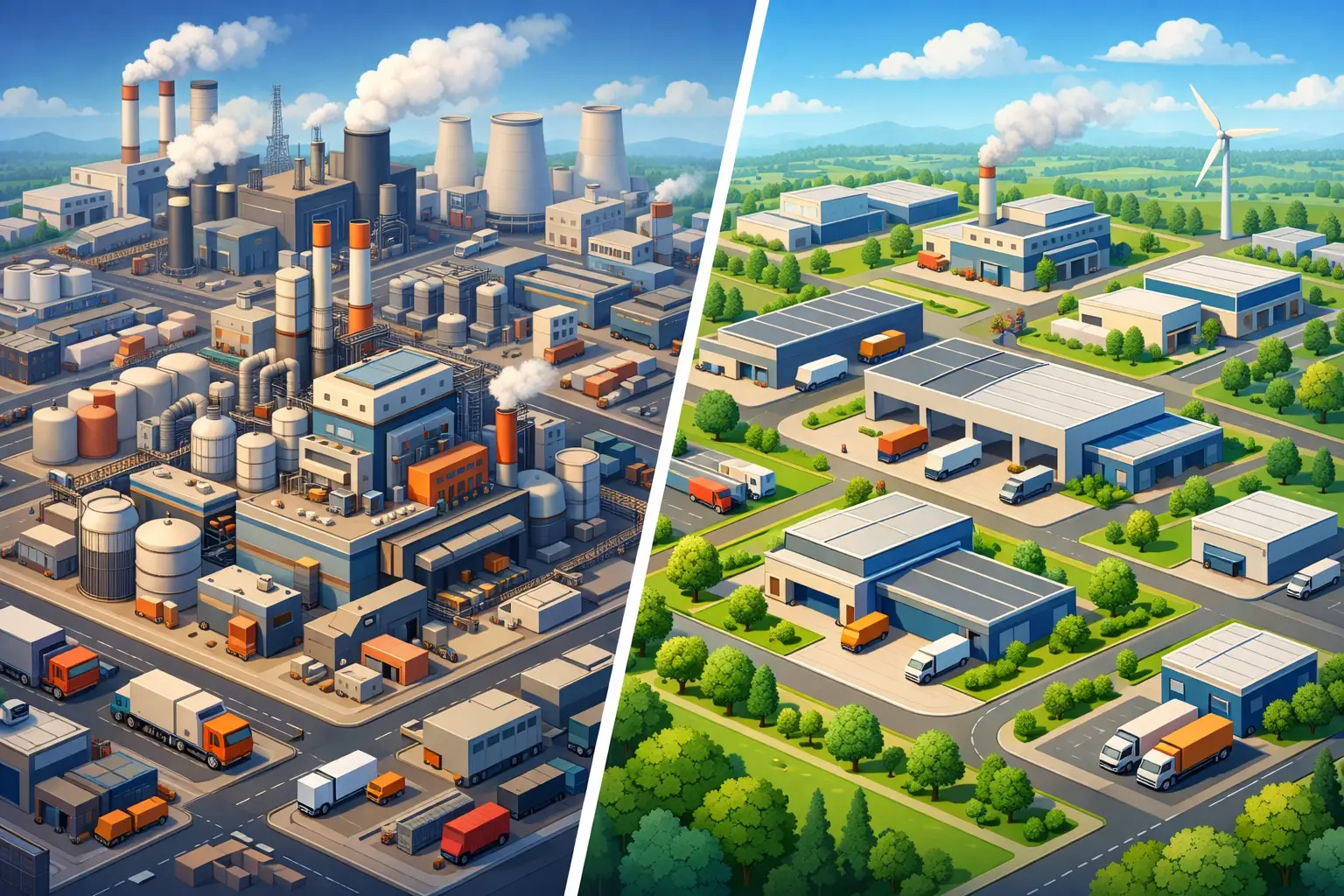
A site can look impressive on paper – serviced land, utility access, a clean master plan – and still be the wrong platform for advanced manufacturing. That is the real issue behind the industrial hub vs industrial park decision. For manufacturers, investors, and strategic partners entering new markets, the question is not simply where to place a facility. It is whether the location can support long-term industrial growth, workforce stability, innovation cycles, and sector-specific expansion.
Too often, the terms are used as if they mean the same thing. They do not. An industrial park is typically a designated area for industrial activity, built around land parcels, basic infrastructure, and occupancy efficiency. An industrial hub is a broader economic ecosystem. It is designed to attract, connect, and sustain industries through infrastructure, logistics, talent, services, and sector clustering that compound value over time.
That distinction matters more now than it did a decade ago. High-value manufacturing is no longer driven by land alone. It depends on supply chain resilience, ESG compliance, specialized facilities, labor access, regulatory coordination, and proximity to research, services, and end markets. In that environment, choosing a conventional industrial park can solve an immediate space requirement while creating strategic limits later.
Industrial hub vs industrial park: the core difference
At its simplest, an industrial park provides space for industrial operations. It may include roads, power, water, drainage, warehouse plots, and factory units. Its primary role is to make industrial occupation possible and efficient. For certain businesses, that is enough. Light assembly, storage, distribution, and straightforward production can perform well in this model if the economics are right.
An industrial hub is built for something larger. It is not just a place where factories sit next to one another. It is a coordinated platform where manufacturing, logistics, technology, workforce support, and business services are planned together. The value comes not only from what each tenant does inside its facility, but from how the wider environment reduces friction and creates growth advantages.
That means the hub model usually includes deeper integration across transport links, utility resilience, shared services, sector-specific building typologies, supplier networks, training pipelines, and often non-industrial assets such as housing, healthcare, retail, and education. The goal is not occupancy. The goal is industrial momentum.
What an industrial park does well
Industrial parks remain relevant because they solve a clear operational need. They offer organized industrial land, predictable zoning, and lower complexity than mixed-use or ecosystem-based developments. For companies with standardized facility requirements and limited need for adjacent innovation infrastructure, this can be a practical fit.
They also tend to work well when speed is the overriding priority. If a business needs warehousing space, a fabrication yard, or a conventional factory shell without major ecosystem dependencies, a park can offer a direct route to market entry. Lower upfront cost may also make sense for smaller operators or firms in early-stage regional expansion.
But that simplicity comes with trade-offs. Industrial parks often stop at the property line. Once a tenant begins to face talent shortages, supplier fragmentation, ESG reporting pressure, limited expansion pathways, or the need for specialized production environments, the park model may show its limits. What looked efficient at launch can become restrictive at scale.
Why the industrial hub model is gaining ground
The rise of advanced manufacturing has changed the site selection calculus. Semiconductor-related production, EV assembly, hydrogen mobility, aerospace-adjacent manufacturing, and renewable energy systems all require more than industrial zoning. They need technical infrastructure, cleaner utilities, precision environments, multimodal logistics, and a workforce ecosystem that supports retention and upskilling.
This is where the hub model becomes strategically stronger. It is designed around industrial interdependence rather than isolated occupancy. A company operating in a true hub benefits from neighboring sectors, institutional support, and infrastructure that has been planned for specialization, not just general use.
That matters for investors as well. Industrial real estate is no longer evaluated only on leaseability or land appreciation. The stronger question is whether a development can become an enduring node in regional and global value chains. Hubs are more likely to achieve that because they can attract anchor tenants, innovation partnerships, and long-cycle capital tied to national industrial priorities.
Industrial hub vs industrial park in infrastructure terms
Infrastructure is one of the clearest dividing lines between the two models. In a standard industrial park, infrastructure is usually designed to meet baseline industrial demand. That includes roads, utility hookups, and parcel access. It supports operation, but not always optimization.
In an industrial hub, infrastructure is strategic. Power capacity, logistics connectivity, digital systems, water management, and facility typologies are often aligned to targeted sectors. A cleanroom-ready manufacturing space, an EV cluster, or a hydrogen mobility zone requires more than generic utility provision. It requires planning around process sensitivity, safety, scalability, and compliance.
The same applies to logistics. A park may offer transport access. A hub is more likely to be positioned around integrated port, airport, highway, and regional trade connectivity because supply chain velocity is part of the value proposition, not an afterthought. For multinational manufacturers, that difference can shape landed cost, customer responsiveness, and export competitiveness.
The talent equation is often the deciding factor
A manufacturing operation does not succeed on infrastructure alone. It succeeds when skilled people can be recruited, retained, and supported over time. This is one of the biggest reasons the industrial hub model is becoming more attractive.
Traditional industrial parks often assume labor will arrive from outside the development. Sometimes that works. Sometimes it produces costly churn, commuting inefficiency, and weak workforce attachment. When advanced manufacturers need engineers, technicians, quality specialists, and operators in sustained numbers, that model becomes fragile.
A well-planned hub addresses the workforce ecosystem directly. Residential options, education and training access, healthcare, mobility, and daily services all contribute to a stronger labor proposition. For employers, this is not a soft benefit. It affects retention, productivity, and operating continuity. For investors, it improves the long-term resilience of the asset base.
ESG, regulation, and future-readiness
Industrial occupiers are under increasing pressure to show progress on emissions, resource efficiency, worker welfare, and governance standards. In a conventional park, ESG performance often depends heavily on what each tenant can build and manage independently. That can create uneven outcomes and higher compliance burdens.
An industrial hub can embed ESG into the development logic itself. Shared systems, smarter land use, integrated services, and sustainability-oriented infrastructure make it easier for occupiers to align with investor expectations and policy frameworks. This matters especially in markets where industrial growth is being shaped by energy transition targets, economic diversification strategies, and global reporting standards.
Future-readiness also depends on expansion flexibility. A business may begin with a single facility and later require adjacent suppliers, R&D space, testing environments, or additional production modules. A park may not be built for that evolution. A hub, if properly master-planned, can support it.
When an industrial park is enough – and when it is not
There is no universal winner in the industrial hub vs industrial park debate because business models differ. If a company needs cost-effective industrial land for conventional manufacturing or storage, and if its labor, supplier, and service needs can be met externally, an industrial park may be entirely sufficient.
But if the operation depends on advanced infrastructure, specialized clustering, export efficiency, workforce integration, or sustained innovation partnerships, the park model may create more friction than value. In those cases, a hub is not a premium add-on. It is a more suitable operating environment.
This distinction becomes especially important for cross-border manufacturers entering the Middle East or other high-growth regions. Market access is only one part of the equation. The bigger issue is whether the location can support industrial leadership over a ten- or twenty-year horizon.
What strategic decision-makers should ask
The right question is not, “Do we need an industrial park or a hub?” The better question is, “What operating model will our business require three expansion cycles from now?” That shifts the discussion from occupancy cost to industrial strategy.
Decision-makers should examine whether the site supports sector-specific infrastructure, expansion phasing, logistics performance, ESG alignment, and workforce sustainability. They should also assess whether the development is positioned as a real economic platform or simply as zoned industrial inventory.
This is where next-generation projects stand apart. A development such as Erisha Smart Manufacturing Hub reflects the hub model at full scale – integrating advanced manufacturing infrastructure with logistics, innovation, and live-work support systems in a way that aligns with how global industry is actually evolving.
The future will not be built in isolated plots. It will be built in connected industrial ecosystems where infrastructure, talent, technology, and capital reinforce one another. That is the frame that makes the industrial hub vs industrial park decision worth getting right.
