
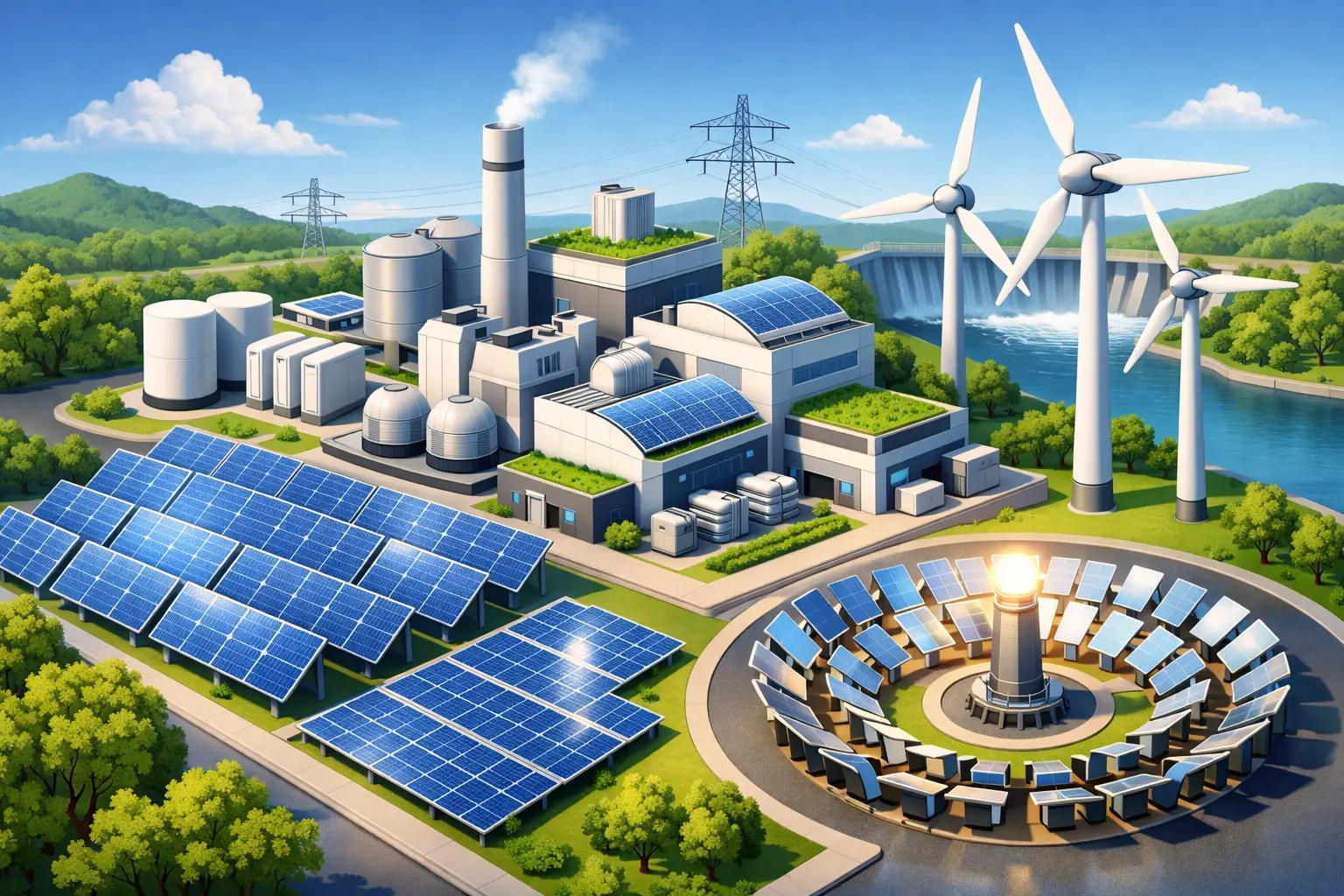
Energy volatility is no longer a background issue for manufacturers. It is a board-level risk with direct consequences for margins, site selection, investor confidence, and long-term competitiveness. That is why the Renewable Powered Factories Future is moving from concept to operating model. For advanced manufacturers, the question is no longer whether renewable energy will shape industrial growth. It is how fast they can build around it.
The shift matters because manufacturing is uniquely exposed to energy pressure. High-load operations, thermal processes, cleanroom environments, cold-chain requirements, and automated production lines all depend on stable, predictable power. When electricity costs swing or grids face strain, production economics weaken. When regulatory pressure increases around carbon intensity, the challenge becomes even broader. Manufacturers are no longer evaluating energy only as a utility input. They are evaluating it as a strategic infrastructure layer.
Why the Renewable Powered Factories Future matters now
Several forces are converging at once. Industrial decarbonization targets are tightening. Capital is favoring assets that can demonstrate ESG alignment with credible operational pathways. Large buyers are scrutinizing Scope 3 emissions in supplier networks. At the same time, energy-intensive sectors such as EVs, battery components, semiconductors, hydrogen systems, and advanced materials are scaling quickly.
That combination changes the logic of industrial development. A factory powered partly or largely by renewables is not simply a greener building. It is a more resilient industrial asset. It can reduce exposure to fossil fuel price shocks, improve carbon reporting, support compliance with customer procurement standards, and strengthen long-term site attractiveness.
This does not mean every factory will operate on 100 percent renewable energy in the near term. That would be an oversimplification. Industrial energy profiles vary widely. Continuous-process manufacturing, heavy heat demand, and specialized precision environments often require layered energy strategies rather than a single-source solution. But the direction is clear. Renewable integration is becoming a core criterion in competitive industrial planning.
What renewable-powered factories actually look like
The phrase can sound abstract, but the operating model is increasingly practical. In most cases, renewable-powered factories combine multiple systems rather than relying on one technology. On-site solar is often the first layer because it is proven, scalable, and well-suited to industrial roofs, parking canopies, and adjacent land. Off-site renewable procurement adds another layer, especially for manufacturers with larger demand profiles than on-site assets can cover.
Energy storage is becoming the critical bridge between intermittent generation and stable operations. Batteries help manufacturers manage peaks, improve power quality, and reduce dependence on expensive peak-hour grid imports. For some sectors, thermal storage can also support process continuity.
Then there is the digital layer. Smart energy management systems now coordinate generation, storage, demand response, and process scheduling in real time. This is where the economics improve materially. A factory that knows when to shift non-critical loads, when to store power, and when to draw from the grid has a far stronger operating position than one that simply consumes energy passively.
For advanced industrial tenants, the future is not a standalone factory with a few solar panels. It is an integrated production environment where energy, logistics, workforce access, water systems, and regulatory readiness are planned together.
The business case goes beyond sustainability
Too many conversations still frame renewable power in manufacturing as a values issue. In reality, it is an industrial performance issue.
The first advantage is cost visibility. Renewable systems, especially when paired with long-term procurement structures, can improve forecasting and reduce exposure to volatile fuel-linked tariffs. That matters for manufacturers making multi-year investment decisions.
The second advantage is market access. Global buyers increasingly expect suppliers to show credible emissions reduction plans. For exporters and multinational manufacturers, renewable power can strengthen procurement eligibility and reduce friction in customer due diligence.
The third advantage is capital attractiveness. Investors and lenders are placing more weight on climate resilience, energy transition readiness, and operational efficiency. Industrial assets that can demonstrate lower carbon intensity and stronger infrastructure planning are often better positioned in serious investment conversations.
The fourth advantage is brand and talent value. High-value manufacturing increasingly depends on skilled technical workforces. Sites that align industrial ambition with cleaner environments and future-facing infrastructure have an edge in attracting and retaining talent.
There are trade-offs, of course. Upfront capital can be significant. Energy storage economics still depend on scale, tariff structures, and usage patterns. Some industrial processes are harder to decarbonize than others. And regulatory frameworks vary by market. But none of these challenges change the direction of travel. They simply mean that the strongest industrial players will be the ones that plan the transition with precision.
Renewable Powered Factories Future depends on location strategy
A factory is only as future-ready as the ecosystem around it. That is where many industrial projects still fall short. They may offer land and buildings, but not the infrastructure logic required for next-generation manufacturing.
Renewable-powered manufacturing works best in locations that combine several advantages at once: reliable grid access, room for distributed generation, logistics connectivity, regulatory clarity, sector clustering, and a labor environment that supports long-term operations. If one of those components is missing, energy strategy becomes harder to execute and more expensive to scale.
This is why integrated industrial hubs are gaining strategic relevance. When power planning, logistics, residential access, education, healthcare, and R&D capacity are developed as part of one ecosystem, manufacturers gain something more valuable than isolated efficiency. They gain operational continuity.
For sectors such as semiconductors, EV components, hydrogen mobility systems, and aerospace-adjacent manufacturing, continuity matters as much as cost. Downtime is expensive. Workforce turnover is expensive. Infrastructure gaps are expensive. The factory of the future needs more than renewable power. It needs a location that treats industrial production as part of a larger economic platform.
That is also where places like Ras Al Khaimah gain relevance in the regional industrial conversation. Lower operating costs, strong port connectivity, investor-friendly frameworks, and room for large-scale industrial planning can make renewable integration more viable over time, especially when paired with sector-specific infrastructure.
The sectors that will move first
Not every sector will adopt at the same pace. The earliest and fastest movers are likely to be industries where customers, regulators, and investors are already forcing the issue.
EV and battery manufacturing are obvious examples because the market narrative is already tied to decarbonization. Producing clean mobility technologies in carbon-intensive facilities creates an increasingly visible contradiction.
Semiconductor and electronics manufacturing will also face pressure, though the challenge is more complex because of precision requirements and energy quality demands. In these sectors, renewable adoption will depend heavily on storage, backup systems, and sophisticated power management.
Hydrogen equipment manufacturing, renewable energy component production, and advanced materials are also natural leaders. Their end markets are directly linked to the energy transition, so production footprints will face scrutiny.
Even conventional sectors will not remain untouched. Food processing, packaging, pharmaceuticals, building materials, and logistics-linked light manufacturing all stand to benefit from lower energy risk and stronger ESG positioning. The timeline may differ, but the strategic logic is spreading across the industrial base.
What decision-makers should evaluate now
For executives assessing new manufacturing capacity, the key issue is not whether renewable power can be added later. The better question is whether the site and operating model are designed to support it from day one.
That means evaluating available roof and land area for generation, grid interconnection strength, storage potential, tariff structures, and energy management capabilities. It also means examining whether the broader development can support workforce attraction, supply chain efficiency, and future expansion without recreating infrastructure constraints in five years.
A narrow site-selection process can produce false savings. A cheaper plot with weak energy planning, poor logistics integration, or limited room for scaling may become far more expensive over the life of the asset. Strategic manufacturers are now looking beyond immediate capex and asking harder questions about resilience, adaptability, and long-term relevance.
This is where ecosystem-led industrial development stands apart. Rana Group’s model reflects a larger truth about the market: the future of manufacturing will be won by platforms that integrate production, sustainability, logistics, and livability into one investable environment.
Building for the next industrial cycle
The factories that define the next decade will not be judged only by output volume or construction speed. They will be judged by how intelligently they manage energy, how well they align with global supply chain expectations, and how effectively they protect long-term operating economics.
Renewable power is becoming part of that baseline. Not because it is fashionable, but because it supports a stronger industrial proposition. It reduces risk, improves credibility, and creates a better foundation for advanced manufacturing growth.
For investors, occupiers, and strategic partners, the opportunity is not simply to place factories in new markets. It is to build in environments where energy transition and industrial performance reinforce each other. That is where the future works.
