
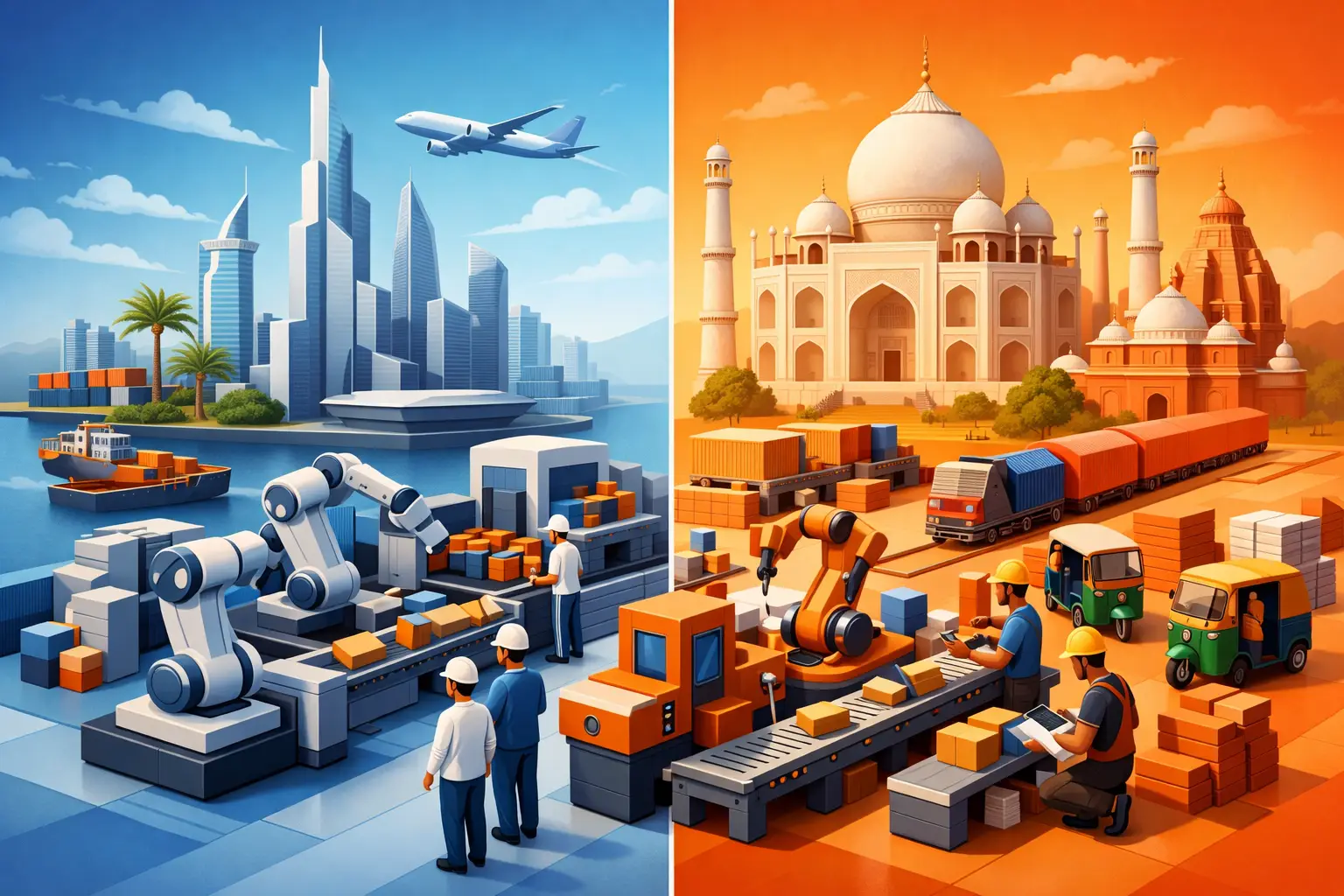
Manufacturing strategy is no longer a simple labor-cost equation. For industrial investors and advanced manufacturers, the real question behind UAE Versus India Manufacturing is where capital moves faster, supply chains stay resilient, and industrial assets remain competitive over the next decade – not just the next quarter.
That comparison matters because both markets are rising for very different reasons. India offers scale, a deep labor base, and a vast domestic market. The UAE offers speed, infrastructure quality, investor-friendly operating frameworks, and direct access to Gulf, African, and global trade corridors. For companies in EVs, clean energy, aerospace-adjacent production, semiconductors, and high-value engineered goods, the decision is rarely about which country is “better” in the abstract. It is about which platform best fits the manufacturing model you are building.
UAE Versus India Manufacturing for global expansion
India is one of the world’s most important industrial growth stories. It has population scale, strong engineering depth, expanding government support for domestic production, and a market large enough to justify long-term localization. If a manufacturer’s strategy depends on serving India from within India, building supplier relationships at scale, and accessing a broad industrial workforce, India deserves serious attention.
The UAE plays a different role. It is not trying to replicate India’s labor scale or domestic consumer depth. Its advantage is precision: faster setup, higher infrastructure consistency, lower friction in trade flows, and a business environment designed for international capital. For a multinational manufacturer, the UAE often functions as a launchpad – a base for regional distribution, advanced assembly, specialized production, or export-oriented operations.
This is where many boardroom conversations go wrong. They compare the two markets as direct substitutes. In reality, they often serve different strategic purposes. India can be the right answer for volume and domestic penetration. The UAE can be the right answer for speed, premium industrial positioning, and regional market access.
Cost is important, but total operating efficiency matters more
On direct labor cost, India typically has the advantage. For labor-intensive manufacturing, that matters. Sectors built around large workforces and repetitive processes may find India more economically attractive, especially when supplier ecosystems are already mature.
But advanced manufacturing does not run on wage cost alone. It runs on throughput, reliability, utility performance, logistics predictability, customs efficiency, compliance clarity, and the cost of delays. A lower-cost workforce does not automatically produce a lower-cost operation if port congestion, approval timelines, fragmented industrial zones, or infrastructure inconsistency create friction.
The UAE’s case becomes stronger when the manufacturing model is capital-intensive, export-oriented, quality-sensitive, or time-dependent. In those settings, a missed shipment, delayed facility approval, or unstable utility environment can cost more than payroll savings. Companies producing high-value components, precision systems, battery technologies, hydrogen-linked equipment, or clean-tech assemblies often prioritize operating certainty over lowest headline labor cost.
That is why sophisticated investors increasingly evaluate landed cost and decision speed, not just nominal cost. The question is not only what it costs to produce. The question is how quickly the plant goes live, how reliably it performs, and how efficiently product reaches target markets.
Infrastructure quality shapes manufacturing competitiveness
India’s infrastructure story is improving. Industrial corridors, freight investments, port modernization, and production-linked policy support are changing the landscape. In the right state, with the right partners, manufacturers can build impressive operations.
Still, the quality of execution can vary significantly by region. Land assembly, utility connections, transport reliability, and local administrative coordination may differ from one state or district to another. That does not mean India lacks industrial readiness. It means execution quality is more location-specific and requires stronger local navigation.
The UAE offers a more compressed and standardized infrastructure proposition. Ports, airports, roads, utilities, and free zone-linked industrial environments are built around trade velocity. That matters when manufacturing depends on imported inputs, regional exports, or just-in-time movement. For companies serving GCC markets or using the Middle East as a multi-market distribution base, this reduces complexity.
For advanced sectors, infrastructure means more than roads and warehouses. It includes cleanroom potential, stable power, logistics integration, specialized industrial zoning, and the ability to support R&D-adjacent operations. This is where master-planned ecosystems have an edge over fragmented industrial estates. A manufacturer does not only need a factory shell. It needs an operating environment that supports talent, suppliers, technical services, and long-term scalability.
Policy and regulatory clarity can change the investment case
India has made major progress in positioning itself as a manufacturing destination. Government-backed incentives and national industrial policy have improved investor confidence. For manufacturers targeting India’s domestic demand, that policy momentum is significant.
But complexity still exists. Approvals, taxation interpretation, state-level variation, and administrative processes can create a steeper setup curve, particularly for foreign companies entering the market for the first time. Experienced operators can manage this. New entrants often underestimate it.
The UAE’s advantage is clarity. Investors generally encounter a more transparent and internationally oriented business environment, especially in structured industrial zones designed for foreign ownership, logistics efficiency, and export-led activity. That clarity shortens planning cycles and supports faster deployment of capital.
For boards making cross-border investment decisions, this matters more than many assume. Capital does not just seek growth. It seeks confidence. A jurisdiction that reduces uncertainty around ownership, licensing, customs, and industrial operation often becomes the preferred location for first-stage regional expansion.
Talent availability depends on the type of manufacturing
India’s workforce scale is unmatched in this comparison. It offers a wide labor pool, engineering talent, and deep technical capability across many industrial categories. For manufacturing models that require large teams, layered operations, or broad in-country supplier development, India holds clear structural advantages.
The UAE competes differently. Its workforce model is international, mobile, and increasingly aligned to specialized sectors. That can be highly effective for advanced manufacturing, especially when the operation requires managerial agility, technical supervision, multilingual coordination, and regional deployment capability.
There is, however, a trade-off. Companies that need very large labor-intensive staffing may find India easier to scale at lower cost. Companies that need specialized, globally integrated teams may prefer the UAE’s ability to attract multinational talent into a high-quality living and business environment.
This is one reason integrated industrial ecosystems matter. Retaining skilled people becomes easier when manufacturing is supported by housing, healthcare, education, logistics, and innovation infrastructure in one environment. That model is becoming increasingly relevant for sectors where talent continuity is as important as factory capacity.
UAE Versus India Manufacturing by sector
The smartest comparison is sector-specific.
India is often well suited to automotive components, textiles, consumer goods, pharmaceuticals, heavy engineering, and large-scale industrial production tied to domestic demand. It can also be highly attractive for companies pursuing supply-chain localization into one of the world’s largest growth markets.
The UAE is especially strong for advanced assembly, clean technology manufacturing, aerospace-adjacent production, energy-transition supply chains, and high-value export-driven industrial models. It also stands out for companies that want access to GCC procurement, Middle East project pipelines, African trade routes, and global shipping lanes without the friction of a more fragmented operating environment.
For EVs, hydrogen mobility systems, renewable energy equipment, and semiconductor-related infrastructure, the decision often depends on where the company sits in the value chain. Upstream, labor-heavy, or mass-market production may favor India. Midstream specialization, regional assembly, and high-speed market access may favor the UAE.
That distinction is critical. The future of manufacturing will not belong to one geography alone. It will belong to networks of production, assembly, innovation, and distribution. The winning platform is the one that fits your exact position in that network.
What industrial investors should really ask
The most effective investment decisions start with a sharper question than UAE or India. Leaders should ask whether they are building for domestic scale, export velocity, supply chain resilience, regulatory simplicity, or advanced-sector clustering.
If your priority is volume production with long-term access to a massive internal market, India may offer the stronger strategic case. If your priority is rapid deployment, premium infrastructure, efficient cross-border trade, and a future-ready industrial base for advanced manufacturing, the UAE becomes highly compelling.
For many companies, the answer is not binary. India and the UAE can work as complementary platforms inside one industrial strategy – India for scale and localization, the UAE for regional headquarters, specialized production, or high-value export operations. That is especially relevant for global manufacturers building diversified footprints rather than betting on a single geography.
The strongest industrial ecosystems are now designed around that reality. They do not just provide land. They create the conditions for long-term production, innovation, and workforce stability. In that context, platforms such as Erisha Smart Manufacturing Hub reflect where the market is moving: toward integrated environments built for next-generation industry, not isolated factories competing on cost alone.
The right manufacturing base is the one that strengthens your position five years from now, when speed, resilience, talent, and infrastructure quality will matter even more than they do today.
