
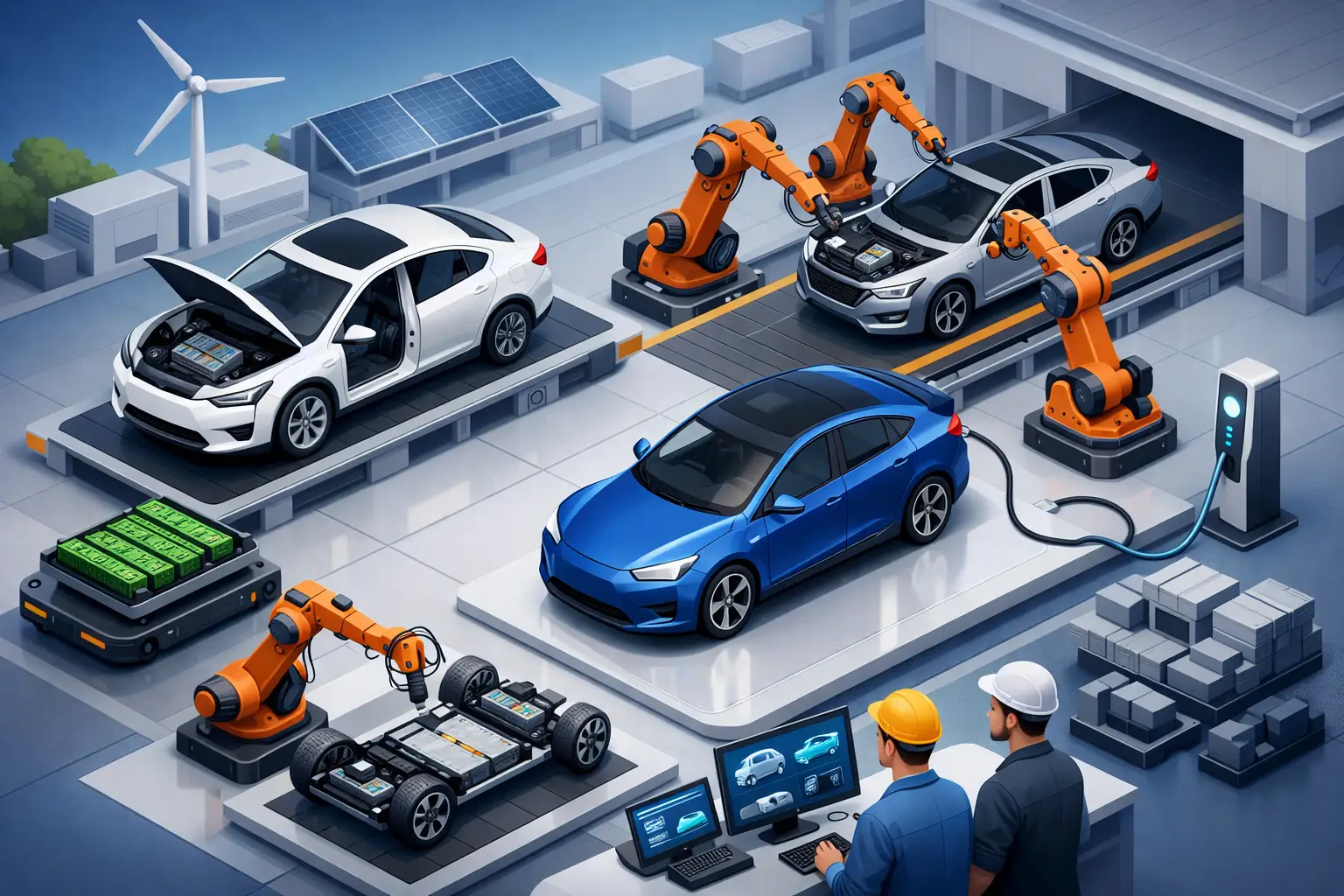
A surprising number of EV assembly plans fail before the first unit is built. Not because the product lacks demand, but because leadership teams underestimate what assembly really depends on: supplier proximity, regulatory alignment, throughput design, workforce readiness, and infrastructure that can scale without constant retrofitting. For companies asking how to launch EV assembly, the real question is not how to start production. It is how to build an operating platform that can survive volume, cost pressure, and market shifts.
EV assembly is often presented as a straightforward manufacturing expansion. In practice, it sits at the intersection of industrial policy, logistics, power reliability, quality control, and capital discipline. That changes the decision-making framework. A plant is not just a building. It is a node in a much larger industrial system, and the strength of that system will shape margin, speed to market, and long-term competitiveness.
How to launch EV assembly with a viable operating model
The first strategic decision is not line layout or equipment selection. It is choosing what kind of EV assembly business you are actually launching. Some manufacturers are entering with full vehicle assembly, including body, paint, and final assembly. Others begin with semi-knocked-down or completely knocked-down operations to reduce early capital exposure and validate regional demand. Both approaches can work. The right choice depends on tariff regimes, local content requirements, supplier maturity, and how quickly the business needs to reach commercial scale.
This is where many projects become distorted by ambition. A leadership team may want the symbolic value of a flagship factory, but the economics may favor phased localization. Starting with a more modular assembly model can shorten time to revenue and reduce execution risk. On the other hand, if the market rewards local manufacturing incentives and the supply base is already forming, delaying deeper integration can leave value on the table.
A serious EV assembly program should be built around a clear answer to four questions: what volume is realistic in the first three years, which components must be localized versus imported, what quality standard the market will demand, and how much flexibility the plant needs to support model changes. Those answers will drive nearly every downstream decision.
Site selection is a manufacturing decision, not a real estate decision
Too many industrial expansions still treat site selection as a land-cost exercise. For EV assembly, that is a costly mistake. The site determines inbound freight economics, export viability, customs efficiency, utility resilience, labor access, and how easily the operation can attract adjacent suppliers over time.
The strongest locations offer more than industrial plots. They provide ecosystem logic. That means port access, road connectivity, investor-friendly regulation, room for phased expansion, and facilities that can support specialized requirements such as battery handling, clean manufacturing environments, testing, and integrated logistics. For multinational manufacturers entering the Middle East, this is where a purpose-built hub can materially compress launch risk.
The trade-off is straightforward. Lower upfront land cost in an isolated location may look attractive on paper, but it often produces higher operating friction later. A more strategic site can reduce transportation dead time, simplify workforce retention, and support supplier clustering. Those gains compound every quarter.
Design the assembly system around throughput, not just equipment
An EV plant does not become efficient because it contains advanced machinery. It becomes efficient because the flow of materials, labor, data, and quality decisions is coherent from receiving to dispatch. That requires discipline in production engineering long before commissioning begins.
The line design should reflect expected model mix, takt time, battery pack integration requirements, traceability standards, and the degree of automation the business can realistically support. Over-automation is a common error in first-time launches. It raises capex, complicates maintenance, and can reduce flexibility when demand patterns change. Under-automation creates quality variability and labor intensity that become hard to correct later.
A more durable approach is selective automation. Automate where precision, safety, or repeatability justify it. Keep other zones adaptable, especially if the operation will evolve from low-volume assembly to broader manufacturing localization. This is particularly relevant for emerging EV markets where product mix can shift quickly.
Digital integration matters here as much as physical equipment. Manufacturing execution systems, traceability architecture, quality data capture, and supplier visibility should be planned from the beginning. Retrofitting digital control after launch usually costs more and delivers less.
Supply chain strategy will decide whether launch stays on schedule
If there is one area that separates credible EV assembly launches from optimistic announcements, it is supply chain realism. Electric vehicles depend on a wider set of critical inputs than many conventional assembly programs, including battery components, electronics, thermal systems, powertrain modules, and software-enabled control units. A delay in one of these categories can idle the line.
That means supplier strategy cannot be an afterthought. It must address sourcing geography, customs lead times, inventory buffering, local warehousing, and long-term localization potential. Executives should stress-test the bill of materials against geopolitical disruption, shipping variability, and single-source dependency.
There is no universal rule on localization speed. In some markets, local supplier development is central to the investment thesis. In others, imported kits with regional final assembly create a better near-term margin profile. The prudent path is usually phased. Launch with a resilient supplier network, then localize high-value or logistically sensitive components as volume justifies it.
This is one reason integrated industrial ecosystems are gaining attention. When assembly, logistics, support services, workforce amenities, and future supplier space are planned together, the plant is not operating in isolation. It is building inside a platform designed for industrial growth.
Regulation, certification, and policy alignment are part of the launch plan
Any executive evaluating how to launch EV assembly should treat regulation as a commercial variable, not a legal box to check. Homologation, import rules, product certification, ESG reporting expectations, battery transport compliance, and worker safety requirements all shape launch timing and cost.
In the Middle East especially, policy alignment can become a major advantage. Governments across the region are using industrial diversification, energy transition goals, and advanced manufacturing strategies to attract next-generation sectors. Manufacturers that align with these priorities often benefit from clearer pathways to licensing, stronger institutional support, and better long-range confidence.
Still, the details matter. Incentives can be attractive, but they do not compensate for weak execution. A plant launched into a favorable policy climate still needs rigorous compliance systems, auditable processes, and a management team that understands cross-border operational governance.
Talent is not just a hiring issue
EV assembly demands a workforce that can operate at the intersection of mechanical systems, electronics, software diagnostics, and quality discipline. Recruiting that workforce is only one part of the equation. Retaining it is often harder.
This is why the broader environment around the factory matters more than many investors initially assume. Housing, healthcare, transportation, training pipelines, and quality-of-life infrastructure affect stability on the plant floor. A standalone factory may secure labor in the short term, but an integrated live-work environment creates the conditions for workforce continuity, stronger productivity, and lower turnover over time.
For operators entering new geographies, training architecture should be built into the launch budget. Assembly teams, maintenance technicians, quality leaders, and line supervisors all need structured ramp-up plans. The launch schedule should account for that reality rather than assume talent can be hired fully ready.
Capital discipline matters as much as industrial ambition
The strongest EV assembly launches are not necessarily the biggest. They are the ones that sequence capital intelligently. That means distinguishing between infrastructure that is essential on day one and capacity that should be added once demand, supplier density, and localization economics are proven.
Phased investment is often the most credible route. Build for operational readiness first. Preserve expansion optionality. Avoid locking the business into oversized fixed costs before the market has validated the next stage. Investors and boards increasingly reward disciplined scale, especially in sectors where growth is real but forecasting can still be volatile.
This is where infrastructure-led platforms have an edge. In a master-planned environment such as Erisha Smart Manufacturing Hub, manufacturers can enter with speed, operate within a sector-aligned industrial setting, and expand into adjacent capabilities without relocating the business. That reduces execution drag at exactly the moment when focus should remain on quality, output, and market capture.
What separates a launch from a headline
An EV assembly launch becomes credible when strategy, infrastructure, and execution are aligned from the start. The market does not reward symbolic industrial moves for long. It rewards factories that can deliver quality vehicles, manage cost, adapt to policy shifts, and scale without operational instability.
For industrial leaders, the opportunity is significant. EV demand is still reshaping supply chains, trade corridors, and manufacturing geography. But the winners will not be the companies that move fastest in press releases. They will be the ones that build on the right platform, in the right location, with the discipline to expand in stages and the foresight to treat assembly as part of a larger industrial ecosystem.
The smartest place to begin is not with the line itself. It is with the operating environment that will determine whether that line performs five years from now.
