
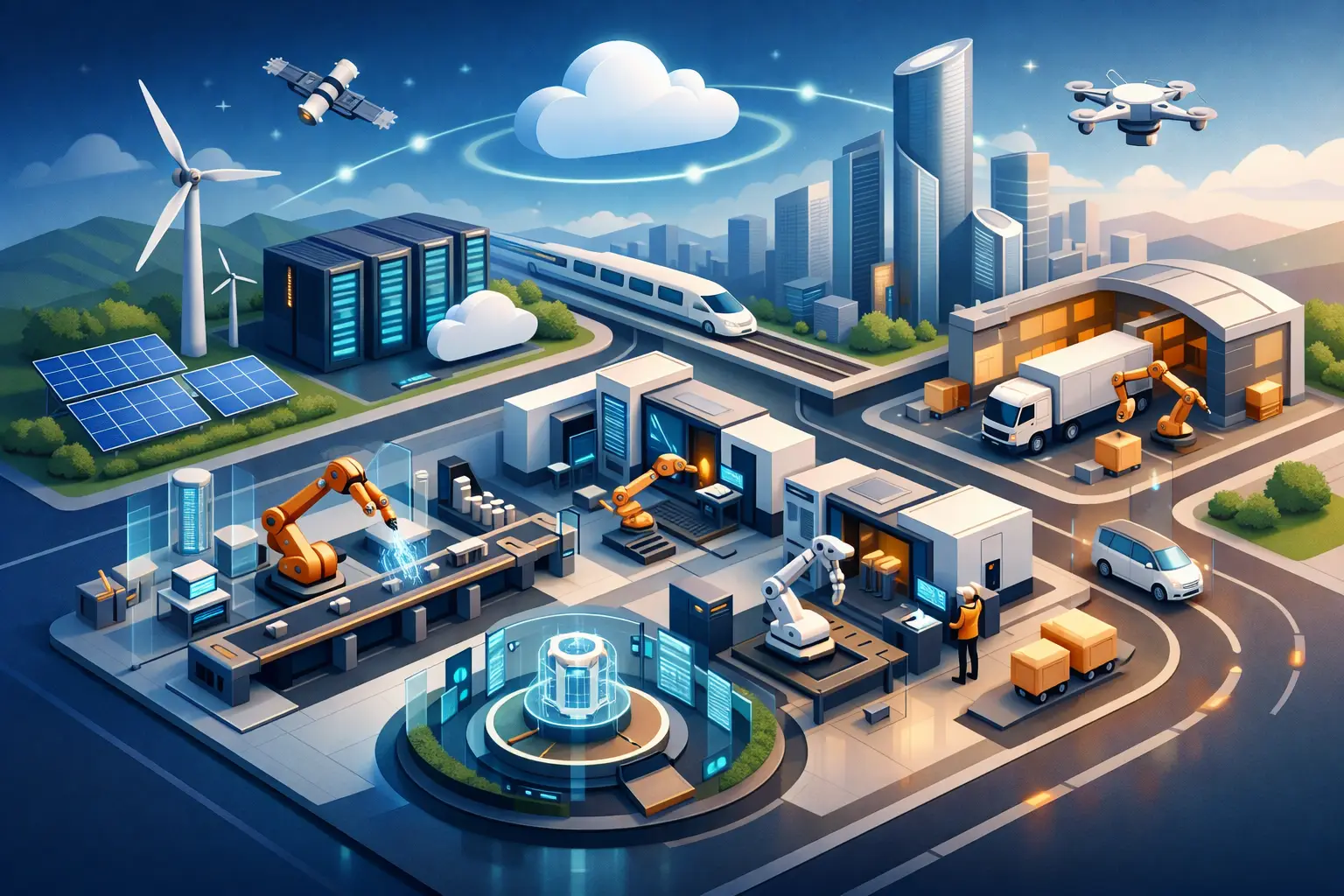
A factory can be built quickly. A competitive industrial base cannot. That is the real distinction in advanced manufacturing infrastructure, and it is where many expansion strategies succeed or stall.
For companies in EVs, hydrogen mobility, semiconductors, clean energy, and aerospace-adjacent production, infrastructure is no longer a background decision. It shapes capital efficiency, hiring strength, utility reliability, logistics performance, compliance timelines, and the ability to scale without constant operational friction. When leadership teams evaluate a new market, they are not simply asking whether land is available. They are asking whether the entire operating environment can support high-value manufacturing for the next decade.
What advanced manufacturing infrastructure actually includes
The term is often reduced to buildings, roads, and power connections. That is too narrow for the sectors driving industrial growth today. Advanced manufacturing infrastructure includes the physical assets required to produce at scale, but it also includes the systems that make those assets commercially viable.
At the facility level, that means purpose-built factories, modular industrial units, logistics zones, warehousing capacity, and specialized production environments such as cleanroom-ready space. For some industries, a generic shell building creates delays from the first day of occupancy. Semiconductor, battery, and precision engineering operators need tighter specifications around vibration control, air handling, redundancy, and utility planning.
At the ecosystem level, the definition expands further. Advanced manufacturing depends on reliable utilities, multimodal access, regulatory clarity, workforce support, housing options, healthcare access, training pathways, and room for suppliers and partners to co-locate. A site may look attractive on a map, yet still fail if operators must solve every surrounding constraint on their own.
That is why the strongest industrial platforms are being designed as ecosystems rather than isolated parks. The infrastructure that matters now is not only what sits inside the plot boundary. It is the operating logic around it.
Why advanced manufacturing infrastructure has become a board-level issue
Ten years ago, infrastructure decisions were often delegated deep into operations or procurement. Today they reach the board because the cost of getting them wrong has increased.
High-growth manufacturers are under pressure from several directions at once. They need faster market entry, lower operating costs, stronger ESG positioning, and better resilience across supply chains. They also face greater technical demands from customers and regulators. If infrastructure cannot support automation, clean energy integration, precision production, and cross-border distribution, the business model becomes harder to defend.
This is especially true in capital-intensive sectors. A company investing in a battery line, hydrogen systems assembly, or advanced electronics packaging does not want to spend its first three years correcting for poor site planning. Every delay in permits, utilities, labor availability, or logistics performance compounds the payback period.
Infrastructure is now tied directly to enterprise value. It affects speed to revenue, margin stability, and expansion optionality. That is why serious investors increasingly assess industrial platforms with the same rigor they apply to market demand and financing assumptions.
The difference between space and readiness
A common mistake in industrial expansion is treating available land as a proxy for readiness. Land matters, but readiness is what determines how fast production can start and how efficiently it can grow.
Readiness means infrastructure has been planned around actual industrial use cases. It means utilities are sized for advanced production, not retrofitted after commitments are signed. It means logistics access is practical for inbound materials and outbound finished goods. It means the development model anticipates specialized fit-outs, phased growth, and the needs of supplier networks.
There is also a strategic timing question. Some companies want fully turnkey space to compress launch schedules. Others need modular units that allow staged capacity expansion while preserving capital discipline. Neither model is universally better. It depends on the maturity of the product, the certainty of demand, and the complexity of the production process. The point is that advanced manufacturing infrastructure should offer options aligned with industrial realities, not force every occupier into the same template.
Why sector specialization matters more than ever
Not all manufacturing has the same infrastructure profile. An EV assembly operation, a hydrogen technology company, and a semiconductor-related manufacturer can occupy industrial space, but their infrastructure requirements are materially different.
This is where sector specialization becomes a strategic advantage. Clusters organized around related industries create more than branding value. They improve supply chain density, support tailored utilities and compliance frameworks, and make it easier to attract skilled labor with relevant experience. They also help investors evaluate the long-term logic of a site. A cluster with a clear industrial thesis is easier to scale than a mixed collection of unrelated tenants.
There are trade-offs. Highly specialized environments can narrow the pool of potential occupiers if the market shifts. Broad industrial zones may appear more flexible. But in advanced sectors, excessive generalization often creates hidden costs. When infrastructure is built for everyone, it is frequently optimized for no one.
The strongest hubs strike a balance. They are broad enough to support adjacent industries, yet specific enough to provide meaningful operational advantages for target sectors such as clean mobility, renewable energy, advanced materials, and high-precision manufacturing.
Infrastructure, talent, and retention are now one conversation
Manufacturing leaders know that labor is not solved by wages alone. High-value production requires technicians, engineers, managers, and support teams who can stay productive over time. That makes workforce infrastructure part of industrial infrastructure.
If employees face long commutes, limited housing options, weak social amenities, or fragmented access to healthcare and education, retention costs rise. Productivity suffers in ways that do not always show up in the initial site model. For advanced manufacturers, this can become a persistent drag on quality and growth.
The more forward-looking approach is to build industrial environments that support live-work-innovate patterns. Residential, healthcare, education, retail, hospitality, and R&D assets are not peripheral features in that model. They are mechanisms for workforce stability and innovation capacity.
This is one reason integrated hubs are gaining traction with global manufacturers. They reduce the distance between production, talent development, and daily life. For companies entering a new region, that can materially improve the attractiveness of the location to both local and international talent.
ESG compliance is no longer optional infrastructure
For investors and multinational operators, ESG alignment has moved from a reporting layer to an infrastructure requirement. Energy efficiency, water management, emissions planning, mobility design, and land-use strategy now influence financing, customer eligibility, and corporate risk.
This changes how industrial space should be evaluated. A low-cost site may look attractive at first glance, but if it creates long-term environmental liabilities or requires expensive retrofits to meet customer standards, its value erodes quickly. By contrast, ESG-compliant infrastructure can support more stable occupancy, stronger investor confidence, and better alignment with national industrial agendas.
There is no single formula here. The right sustainability profile depends on sector, production intensity, and market commitments. Still, the direction is clear. Advanced manufacturing infrastructure must be designed for a lower-carbon, more resource-aware industrial economy.
What investors and manufacturers should look for
The best industrial platforms answer practical questions before tenants need to ask them. Can the site support heavy and high-precision production? Are there clear pathways for phased expansion? Is logistics access built for international trade? Will the surrounding ecosystem help retain talent? Does the infrastructure align with ESG and sector-specific compliance demands?
Decision-makers should also examine whether the developer thinks like an ecosystem builder or a land seller. That distinction matters. A credible platform is designed around long-term industrial growth, not short-term occupancy. It anticipates supplier integration, community support, sector clustering, and the operational realities of advanced production.
This is the shift defining next-generation industrial development. The market is moving beyond standalone facilities toward environments where manufacturing, logistics, workforce support, and innovation capacity reinforce one another. Rana Group has positioned this model at the center of its industrial vision, reflecting where serious capital and serious manufacturers are headed.
Advanced manufacturing infrastructure is not a backdrop to growth. It is the structure that determines whether ambition can scale. For companies planning their next move, the better question is not whether a site can host production. It is whether it can carry the weight of the future you intend to build.
