
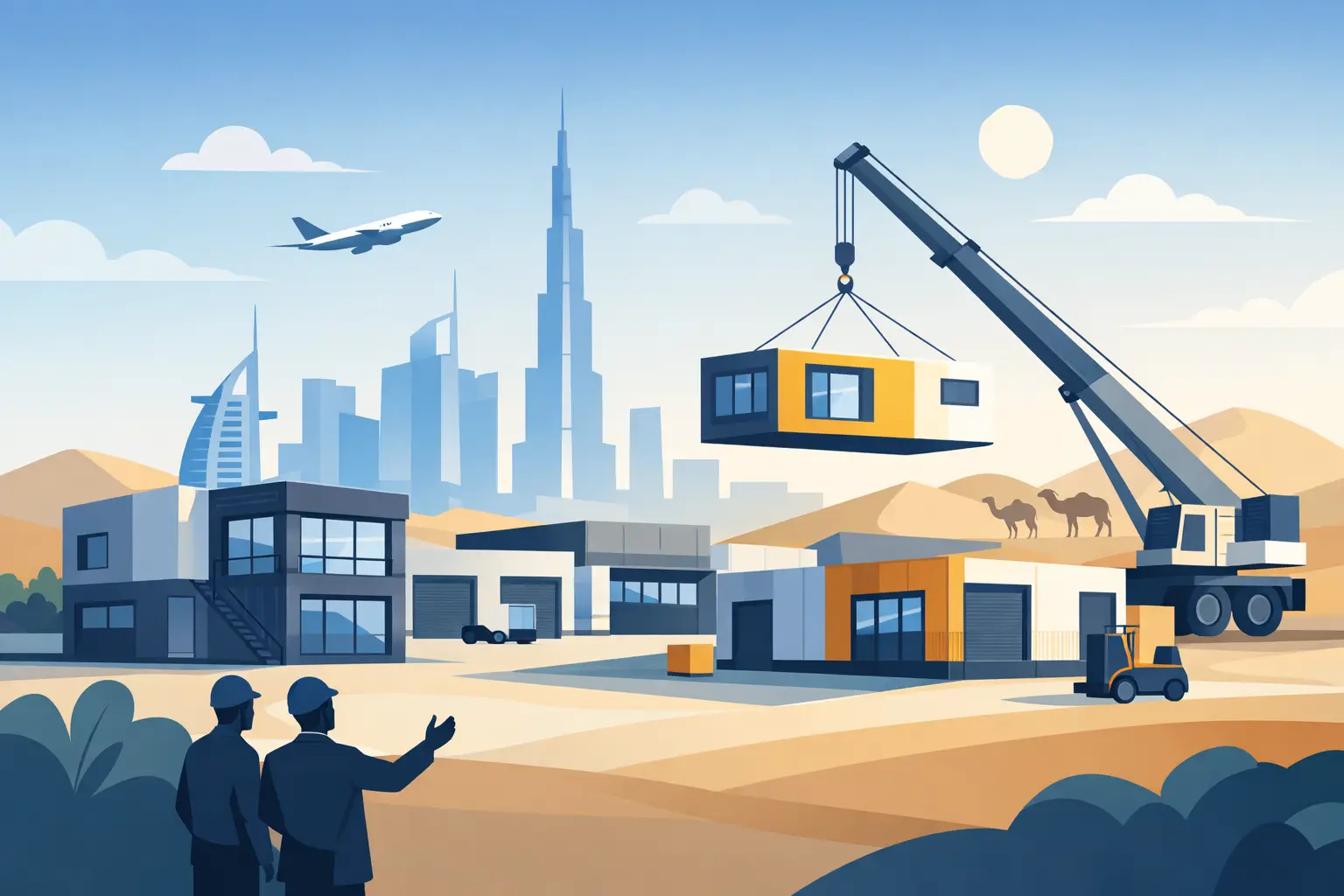
A delayed factory launch in the Gulf rarely fails because demand disappeared. It fails because the site was not ready, approvals took longer than expected, or the facility could not adapt once production assumptions changed. For industrial investors entering the region, that gap between strategic intent and operational readiness is where value is won or lost. This is exactly why modular industrial units in the UAE are gaining ground.
They answer a hard commercial question: how do you establish industrial capacity quickly, without overcommitting capital or compromising long-term growth? In the UAE, where advanced manufacturing is moving from policy ambition to physical delivery, modular formats are becoming a practical way to accelerate that decision.
What modular industrial units UAE investors are really buying
At first glance, a modular unit looks like a faster route to occupancy. That matters, but speed alone is not the full story. For manufacturers, logistics operators, and technology-led industrial businesses, the real value is optionality.
A modular industrial unit allows an occupier to start with the capacity it needs now and expand in phases as contracts, demand, and supply chain relationships mature. That is a very different proposition from taking a large conventional site and absorbing the cost of underused space for years. In sectors such as EV components, hydrogen systems, power electronics, precision assembly, and clean-tech manufacturing, where product cycles and scaling assumptions can shift quickly, that flexibility has strategic weight.
It also changes the nature of entry risk. Instead of treating industrial expansion as a single, fixed real estate decision, modular development turns it into a staged operating model. Companies can test throughput, labor availability, logistics performance, and regional demand before committing to larger footprints. For boards and investment committees, that often makes regional expansion easier to underwrite.
Why the UAE is especially suited to modular industrial growth
The UAE has become one of the region’s strongest platforms for industrial expansion because it combines policy support with export connectivity and investor-oriented regulation. But industrial success here still depends on execution at the asset level. A market can be attractive on paper and still create friction if facilities are slow to deliver, poorly configured, or detached from workforce and logistics needs.
This is where modular industrial units fit the UAE context well. Many inbound manufacturers are not looking for generic warehousing. They need production-ready environments, utility planning, room for technical fit-out, and expansion pathways that do not require relocation after the first growth phase. They also need access to ports, regional markets, and cost structures that remain competitive as output rises.
The UAE’s industrial strategy increasingly favors infrastructure that is scalable, sector-aware, and aligned with economic diversification goals. Modular formats support that shift because they can accommodate a broad range of occupiers while still allowing specialization. A unit designed for advanced assembly, light industrial production, or technical manufacturing can be configured more intelligently than a traditional speculative shell, especially when delivered within a larger master-planned ecosystem.
Speed matters, but fit matters more
The most obvious case for modular units is reduced time to market. If a company can move into a functional industrial space sooner, it can shorten the gap between market entry and revenue generation. In sectors facing regional demand windows or time-sensitive supply agreements, that advantage is material.
Still, speed without technical fit creates expensive rework. A fast handover only helps if power load, circulation, clear heights, utility access, compliance requirements, and future adaptation have been considered upfront. That is why serious occupiers should look beyond marketing claims about rapid delivery and ask a more useful question: is this facility built for the operating model, or just built quickly?
In the UAE, the strongest modular industrial propositions are not simply smaller buildings delivered faster. They are facilities planned around industrial use cases, with room for phased growth and integration into a wider infrastructure platform. That distinction matters for multinational manufacturers that expect to scale from assembly to more advanced production over time.
The capex argument is stronger than most people admit
Capital discipline is now central to expansion strategy. Even well-funded industrial groups are more cautious about committing large sums to fixed assets before local demand and supply chain depth are proven. Modular units help by reducing the amount of capital tied up in day-one capacity.
That does not always mean the lowest long-term cost. A fully bespoke plant on owned land may be more efficient over a long enough horizon, especially for very large or highly specialized operations. But many companies do not begin there. They begin with uncertainty around exact throughput, local sourcing rates, product localization timelines, and workforce ramp-up.
For those businesses, modular units can improve the economics of entry. They limit the cost of oversizing, reduce the burden of idle space, and let investment follow operational evidence. The result is a more defensible path from pilot production to scaled manufacturing.
Modular industrial units UAE occupiers should evaluate carefully
Not every modular facility is suitable for advanced industry. Some are effectively standardized boxes with limited adaptation potential. Others are more sophisticated, with infrastructure designed to support technical production, clean processes, specialized storage, or future automation.
Occupiers should assess three things closely. First is expandability. Can the unit scale within the same site or cluster, or will growth force a disruptive move? Second is utility readiness. Industrial users in energy-intensive or precision-led sectors need clarity on power, water, ventilation, loading, and process support from the start. Third is ecosystem value. A well-located unit inside a broader industrial platform can outperform a cheaper standalone option if it improves talent access, logistics efficiency, and partner proximity.
This is especially relevant in the UAE, where industrial developments are increasingly competing not just on land or lease rates, but on their ability to support advanced sectors with integrated infrastructure. A company entering the region for long-term growth should be thinking beyond the first unit and asking what the surrounding environment enables over five to ten years.
Why ecosystem design changes the modular equation
A modular industrial unit is more valuable when it is part of a coordinated industrial environment rather than an isolated real estate product. That is because manufacturing performance does not depend on the building alone. It depends on the people, suppliers, transport links, support services, compliance environment, and quality of life that surround it.
For industrial tenants with regional ambitions, workforce retention and operational continuity are no longer side issues. If a site is difficult to staff, disconnected from essential services, or poorly linked to logistics infrastructure, the apparent savings of a basic unit can disappear quickly. By contrast, a live-work-industrialize model supports labor stability, executive mobility, and higher tenant stickiness.
This is where developments such as Rana Group’s platform in Ras Al Khaimah shift the discussion. The proposition is not simply modular space. It is modular space within a larger manufacturing ecosystem that brings together industrial assets, logistics capability, sector-specific planning, and supporting residential, healthcare, education, retail, and R&D components. For occupiers in EVs, hydrogen mobility, semiconductors, renewable energy, and aerospace-adjacent manufacturing, that broader framework can materially improve execution.
When modular is the right choice, and when it is not
Modular industrial units are not the answer to every expansion strategy. If a business requires extremely specialized production layouts, heavy process integration, or a very large permanent footprint from day one, a bespoke facility may make more sense. There are also cases where land ownership and custom design are central to long-term margin strategy.
But for many industrial entrants to the UAE, modular is the smarter first move. It supports faster establishment, lower initial exposure, and staged growth in a market where demand is rising but operational assumptions still need validation. It is particularly well suited to companies entering new regional supply chains, launching localized assembly, or building a beachhead before full-scale manufacturing.
The more strategic point is this: modular should not be understood as temporary or secondary. In the right setting, it is a disciplined way to build industrial presence with precision. It lets companies match infrastructure to evidence rather than ambition alone.
The future of manufacturing in the UAE will not be shaped only by landmark factories. It will also be shaped by how intelligently industrial capacity is deployed in the early stages of growth. For investors and operators who want speed, control, and room to scale, modular industrial units may be the clearest signal that the region is moving from industrial promise to industrial readiness.

[…] with speed at any cost. A poorly phased cluster can lock in underused assets. The better model is modular growth – starting with core demand drivers, enabling infrastructure, and expansion capacity that can […]
[…] Manufacturers need facilities that match technical specifications from day one, whether that means modular industrial units, turnkey factories, high-capacity utilities, or precision-ready environments. Delays in facility […]
[…] time to operation. Investors and occupiers value speed as much as scale. Turnkey factories, modular industrial units, clear development phasing, predictable approvals, and integrated infrastructure can materially […]
[…] starts with site readiness. Manufacturers need more than zoned land. They need turnkey factories, modular industrial units, logistics facilities, and specialized spaces that can support cleanroom standards, precision […]
[…] it is planned for advanced production sectors, not retrofitted after the fact. Turnkey factories, modular industrial units, logistics facilities, and cleanroom-ready spaces matter because aerospace-adjacent production […]
[…] means purpose-built infrastructure for advanced manufacturing tenants, including turnkey factories, modular industrial units, logistics facilities, and cleanroom-ready spaces for semiconductor-linked activity. It also means […]
[…] infrastructure inside a master-planned environment. Companies seeking turnkey factories, modular industrial units, logistics support, or cleanroom-ready spaces need more than available square footage. They need […]
[…] value is in purpose-built infrastructure. Turnkey factories, modular industrial units, logistics facilities, and cleanroom-ready semiconductor spaces create conditions where AI can be […]
[…] changes that equation is infrastructure readiness. Purpose-built factories, modular industrial units, logistics assets, cleanroom-ready spaces, sector-specific clusters, and integrated support systems […]
[…] control systems all need to match the intensity of the intended manufacturing process. A modular industrial unit can work well for some occupiers, while others need a turnkey facility or a highly customized shell […]
[…] turnkey facility, modular industrial unit, or built-to-spec environment can outperform a conventional financial incentive because it […]
[…] fragmented warehousing, or repeated modifications to meet technical requirements. An ecosystem with modular units, turnkey options, logistics support, and workforce-adjacent amenities may carry a different […]